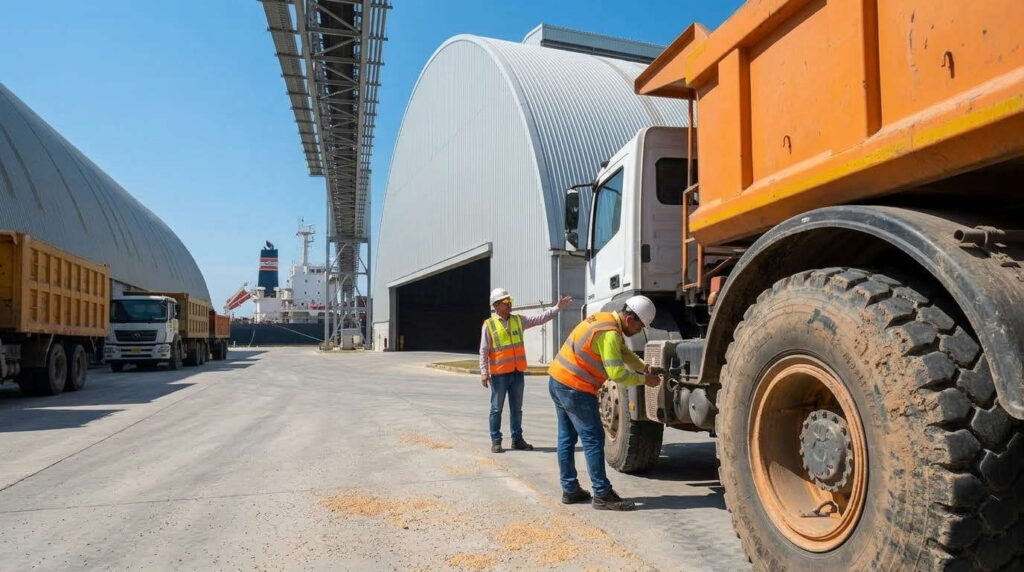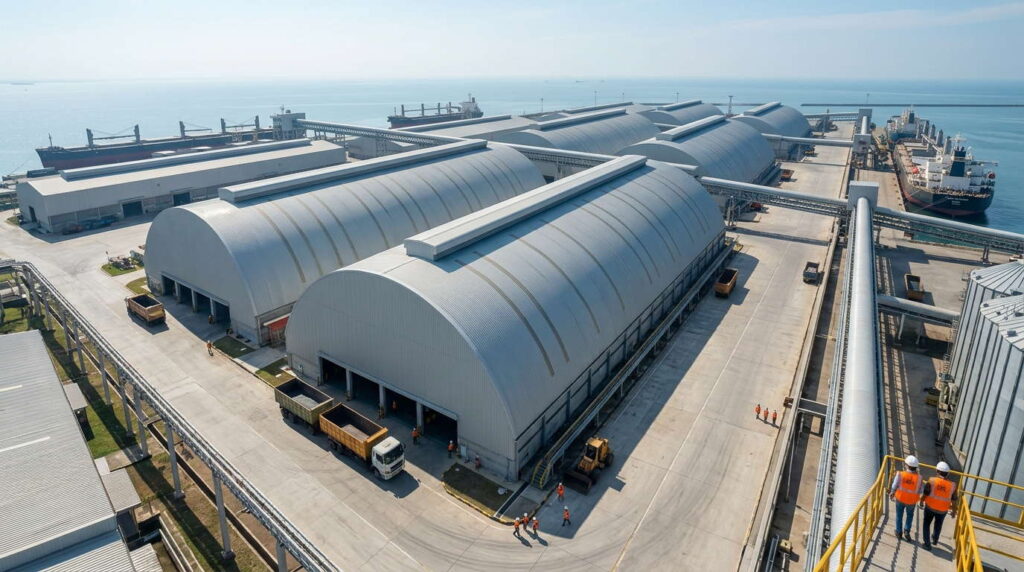
80m Clear-Span Arch Vault Bulk Sheds
Fabricated in Deep-Water Maritime Terminal. C5-M coating, bolted trial assembly. Delivered 20 Days Ahead of Vessel Berthing Date.
Project Facts
The commercial and technical facts a contractor checks before requesting drawings.
| Industry | Port Dry Bulk Transit & Conveying Logistics |
|---|---|
| Location | Deep-Water Maritime Terminal, Indonesia |
| Project Scale | 120,000 sqm Complex (~16,800 Tons Structural Steel) |
| Design & Execution | 0% Overhead Hot-Work (100% Bolted Splices) |
| Service Environment | ISO 12944 C5-M (Marine Heavy-Duty Protection) |
| Delivery Result | Delivered 20 Days Ahead of Vessel Berthing Date |
| Our Scope | Fabrication, C5-M coating, bolted trial assembly and delivery |
Project Overview
How the structure was engineered, fabricated and delivered in Deep-Water Maritime Terminal.
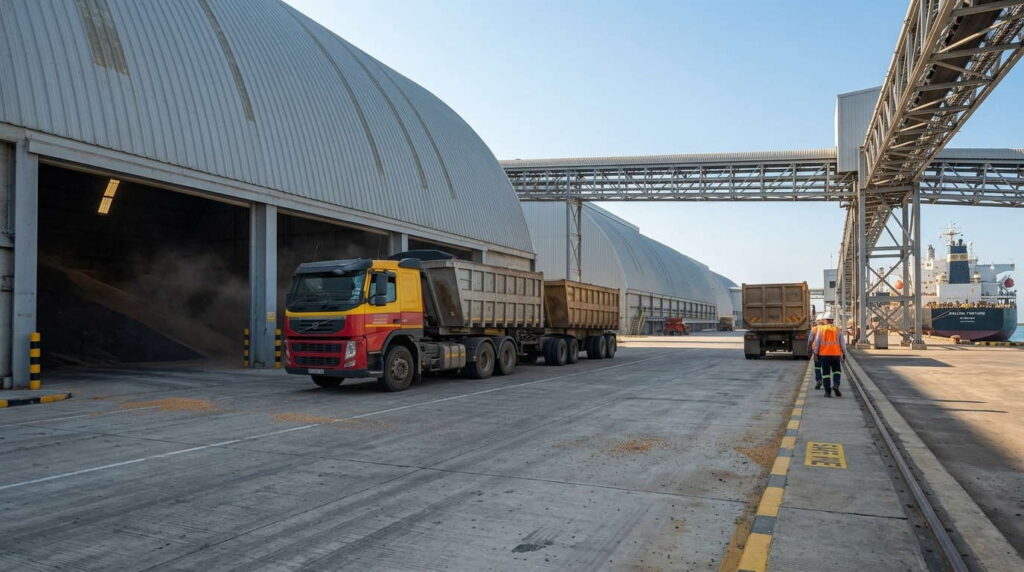
Located at a critical deep-water maritime logistics hub in Indonesia, this mega transit complex handles millions of tons of dry bulk cargo annually, transferring materials directly between ocean-going bulk carriers and processing centers.
For the port authority and EPC construction team, the project had two major commercial stress points: astronomical ship demurrage costs and extreme tropical marine corrosion.
Berth space at the terminal is leased at premium rates; every extra day spent installing roof arches above active ship loaders risked halting conveyor trials, which triggers demurrage fines of up to tens of thousands of dollars per vessel per day.
Furthermore, the equatorial coastal site exposes steel to constant saline sea breezes, high humidity, and abrasive bulk mineral dust, which can cause unprotected steel structures and standard zinc roofing to rust within two to three years.

Four Decisions That Made It Work
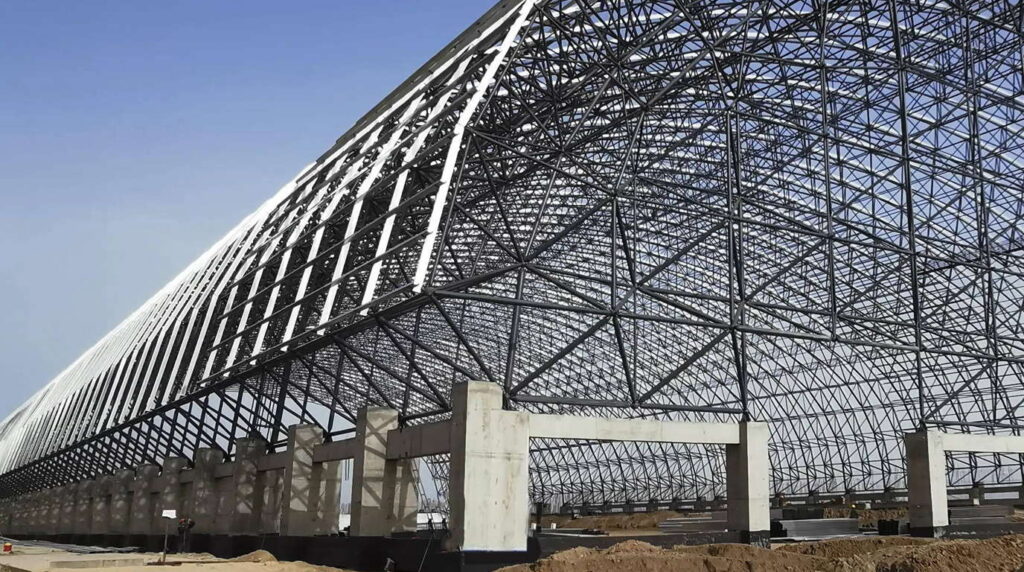
80m Column-Free Space Truss Arch
Engineered with continuous spatial triangular tube trusses, maximizing interior vertical clearance for stacker-reclaimers and payload tipping trucks while
Zero-Hot-Work Coastal Rapid Assembly
Fabricated with self-aligning flanged sleeve connections, allowing heavy arch spans to be assembled on ground aprons and hoisted directly without on-site c
ISO 12944 C5-M Coastal Corrosion Resistanc
Steel members received a deep hot-dip galvanized primer coupled with high-build aliphatic polyurethane, providing over 25 years of design life in aggressiv
Integrated Aerodynamic Ridge Ventilation
Equipped with continuous natural ridge ventilators along the crown, purging internal humidity and airborne cargo dust while maintaining storm-proof water t
The Project, As Built
Completed works, structural details and the delivery team on site.


Client Testimonial
Feedback recorded from the client after handover.
With Panamax bulk carriers queuing offshore, delayed shed erection meant tens of thousands daily in ship demurrage. Shijie's 80m arches landed with flawless precision: guide pins snapped directly into base seats with 100% bolted accuracy aloft—not a single torch cut near conveyor lines.
Frequently Asked Questions
Answers engineers ask before committing to a scope like this.
What was delivered at this Indonesian deep-water terminal?
A 120,000 sqm dry bulk transit complex on roughly 16,800 tons of steel, moving material directly between ocean-going bulk carriers and the terminal’s conveying and processing systems.
Why 80-metre clear span instead of a conventional column grid?
Stacker-reclaimers and tipping trucks need unobstructed height and travel. An 80m column-free space truss arch maximizes interior clearance, removes columns from the stockpile zone entirely, and reduces foundation count on a quay-side site where piling is expensive.
Vessel demurrage is the real cost driver. How was erection accelerated?
The arch trusses are modular with self-aligning flanged sleeve connections, so spans are assembled on the ground apron and hoisted directly. Components arrive pre-sorted on dockside flatbeds for immediate hook-lifting, keeping crane time off the critical path next to active ship loaders.
Marine salt spray destroys steel at this site. What is the protection system?
Hot-dip galvanizing as the primary barrier plus a high-build aliphatic polyurethane topcoat to ISO 12944 C5-M, specified for a design life beyond 25 years in tropical marine atmosphere. Roof cladding uses AZ150 high-build fluorocarbon-coated steel.
Is any welding done overhead at the quay?
None. All splices are bolted, so there is 0% overhead hot work. That matters at an operating terminal: no hot-work permits, no fire watch over cargo, and no risk of weld spatter reaching ship loaders or conveyor belts.
Get Your 24-Hour BOQ and Cost Plan
See how much steel tonnage and ocean freight you can save before fabrication begins
Steel Weight Savings
1:1 Tekla 3D modeling optimizes beam-column ratios to eliminate redundant material costs.
Zero-Clash Code Verification
Checked against EN 1090 and local wind/seismic loads.
Engineer-to-Engineer Review
Verified by our lead engineers—Zero pushy sales calls, Just actionable data and factory price.
CE EN 1090-1•ISO 9001•ISO 14001•ISO 45001
Lead Engineers Online
🔒 100% Private and Secure, No Spam