
What infrastructure demands that a building code never asks for
A bridge or a port structure is loaded millions of times, inspected for decades and never closed for maintenance if it can be avoided.
A building is designed for the worst hour of its life. A bridge is designed for the ten millionth truck that crosses it.
SynJect builds infrastructure steelwork to fatigue categories and marine corrosion classes rather than to building codes.
Infrastructure is governed by fatigue, not by static strength. A highway bridge girder may see 2×10⁶ stress cycles over its design life, and a jetty in a marine environment sits in C5-M corrosion for the same period. Neither condition exists in a warehouse frame, and neither can be added by coating it later.
The governing standard is different too: EN 1993-1-9 for fatigue, AASHTO or AREMA for live load, and the marine exposure class for everything the salt reaches.
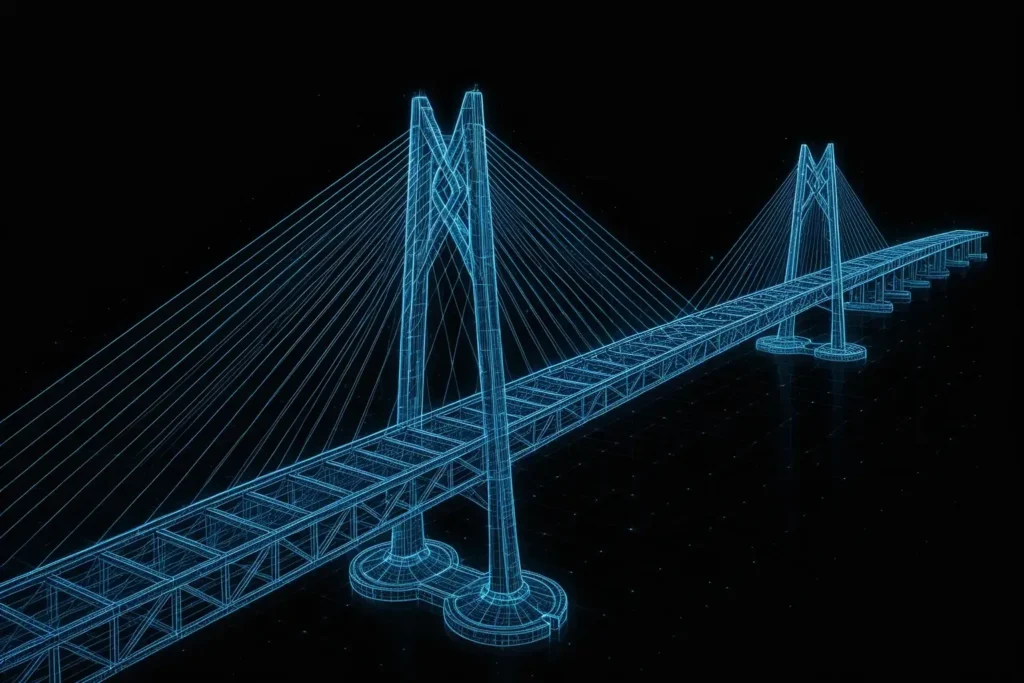 Structural model · Steel Infrastructure
Detail for fatigue, not for yield
Fatigue life is decided by the detail category at the weld toe, not by the member size. We choose detail categories to EN 1993-1-9, keep attachments away from tension zones and specify weld profiles that survive millions of cycles.
Marine exposure from the splash zone up
Salt spray reaches 20 km inland and concentrates at joints, bolt heads and the splash zone. We specify C5-M systems with duplex coating and sealed connections, plus stainless or hot-dip galvanized fasteners throughout.
Displacement and rotation allowed for
Bridges and long stations move. Bearings, expansion joints and the connection details are designed for the calculated rotation and displacement, so the structure does not fight its own thermal and traffic movement.
Inspection access designed in
Every critical weld needs to be reachable in 30 years. We put walkways, ladders and inspection platforms into the structural model, with lifting points for future maintenance rather than scaffolding the whole span.

Talk to an Engineer
Share your project drawings, span requirements, or BOQ with our structural engineering team for a tailored preliminary scheme and quotation.
Infrastructure Steel Structures structural specification matrix
The values below are the design envelope we work to for each housing type. Final figures are fixed by your site wind and snow data, the equipment integrator’s layouts and the local building code.
| Parameter | Highway bridge | Rail station canopy | Port / jetty | Transmission tower | Marine terminal |
|---|---|---|---|---|---|
| Span | 30–80 m | 20–45 m | 25–60 m | 200–400 m | 30–60 m |
| Governing load | traffic + fatigue | roof + crowd | crane + wave | wind | crane + wind |
| Fatigue detail | EN 1993-1-9 cat. 71–90 | cat. 80–100 | cat. 71–80 | cat. 90+ | cat. 71–80 |
| Corrosion class | C4–C5 | C3–C4 | C5-M | C4 | C5-M |
| Deflection limit | span/400 | span/250 | span/400 | height/200 | span/400 |
| Inspection access | designed gantries | roof access | walkways | climbing system | walkways |
Infrastructure Steel Structures questions, answered
The questions we get asked most by farm owners, integrators and EPC contractors before they commit to a design.
01Why is fatigue more important than strength for a bridge?
A bridge that is strong enough can still crack after a few million truck cycles. Fatigue life is governed by the detail category at each weld toe, so we design to EN 1993-1-9, keep attachments out of tension zones and specify weld profiles that survive the design cycle count.
02What corrosion class applies to a port or jetty?
C5-M for marine exposure, rising to the splash zone where salt, wetting and abrasion combine. That means duplex coating systems, sealed connections and stainless or hot-dip galvanized fasteners, not a standard building coating.
03Can you design to AASHTO or AREMA instead of Eurocode?
Yes. We work to the governing code for the project - EN, AASHTO or AREMA - and will state in the calculation report which standard governs each load case so the checking engineer can follow it.
04How do you allow for thermal movement on a long bridge?
Through bearings, expansion joints and connection details designed for the calculated rotation and displacement. Restraining that movement instead of accommodating it transfers the force into the abutments and eventually cracks the welds.
05Is inspection access really part of the structural design?
It should be. Every critical weld needs to be reachable decades later, so we include walkways, ladders and lifting points in the model rather than leaving the owner to scaffold an entire span for a five-minute inspection.
06What documentation comes with an infrastructure package?
Mill certificates, WPS and PQR records, NDT reports to the agreed percentage, dimensional inspection sheets, coating thickness reports and as-built drawings, compiled as an MDR for handover to the asset owner.
07When should maintenance access be considered for bridge or port steelwork?
Plan inspection and maintenance access alongside the protective coating strategy, rather than after the structure is built. Exposure, service environment and access restrictions should be considered by the project team when specifying protection.
08What should be provided when requesting an infrastructure steel quotation?
Provide the site location, drawings or preliminary geometry, applicable design criteria, load information, coating requirements and intended delivery and installation scope. Identify the approving authority and any required inspection records so responsibilities can be agreed.
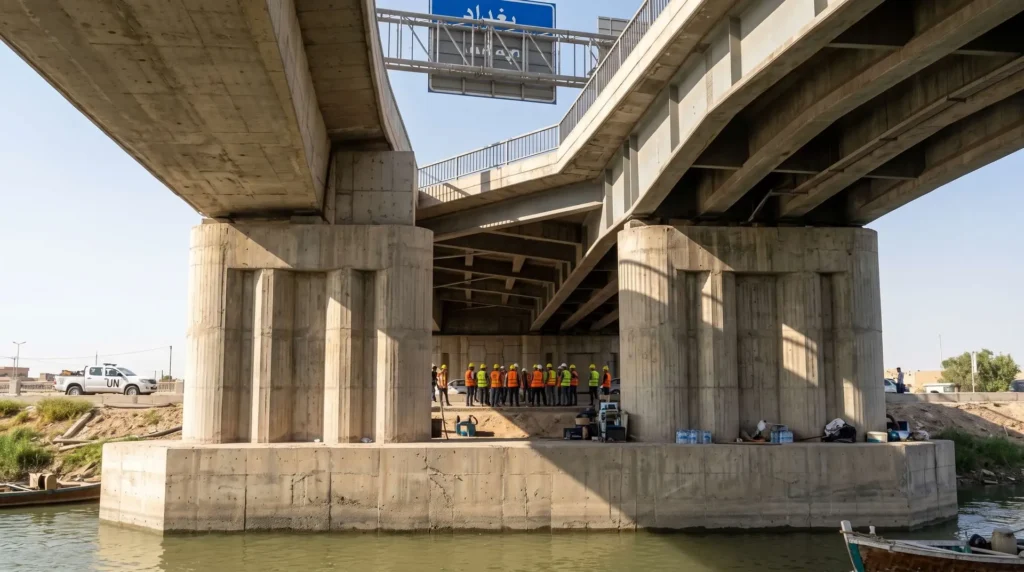
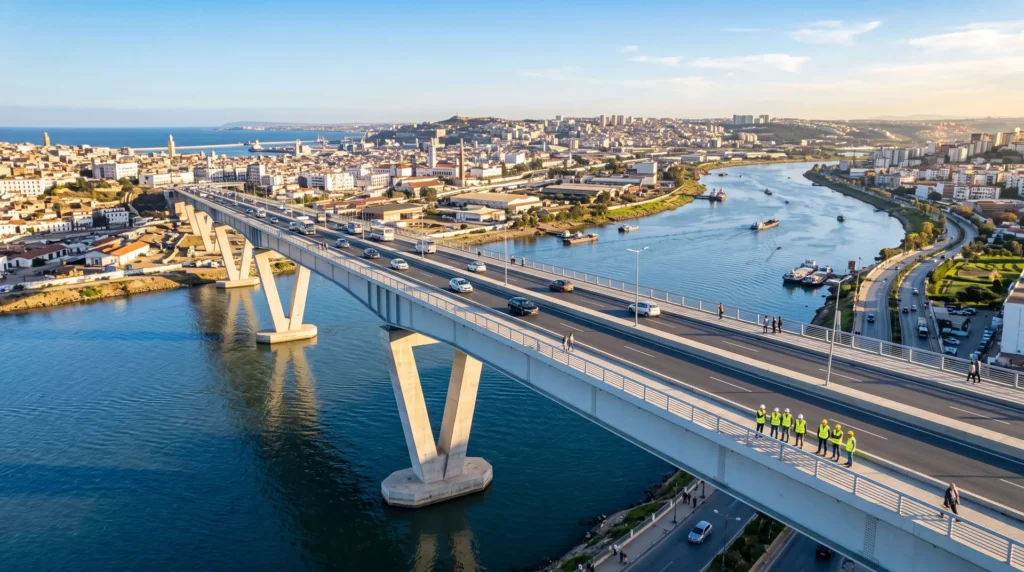
Infrastructure projects in service
Bridges, canopies, ports and towers we have fabricated and shipped.
Five tables in one PDF: clear spans and eave heights by housing type, equipment collateral loads, corrosion specification, ventilation parameters and the certification list.