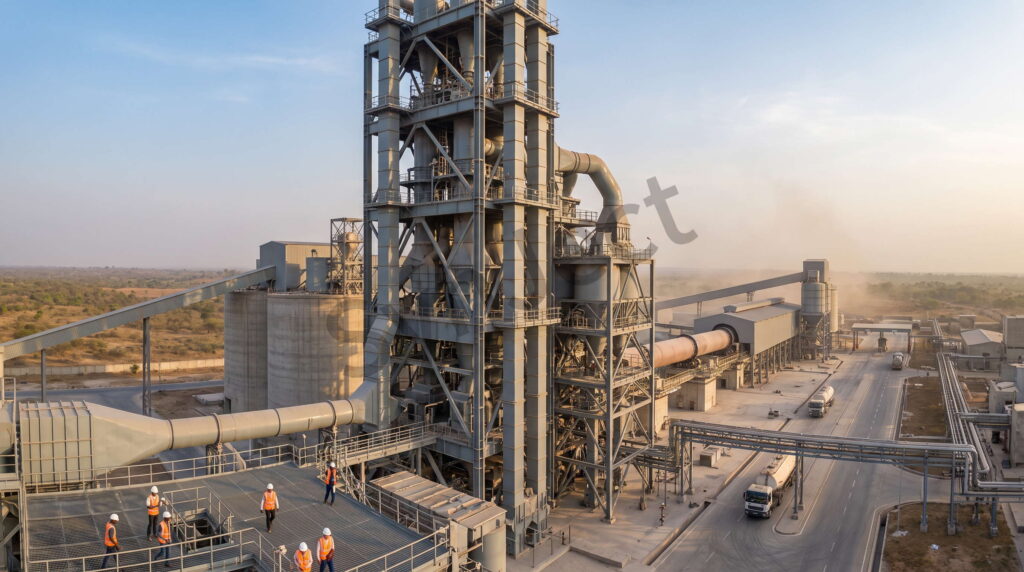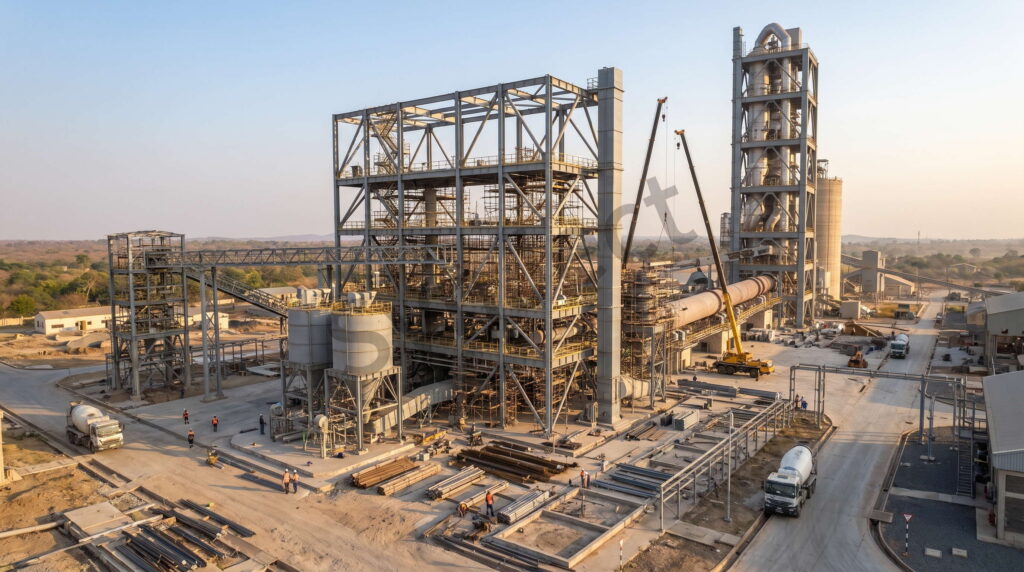
85-Meter Heavy Industrial Preheater Tower
Fabricated in Inland Industrial Belt. C4 coating, shop assembly. Completed 22 Days Ahead of Kiln Ignition Date.
Project Facts
The commercial and technical facts a contractor checks before requesting drawings.
| Project Scale | 85m Total Height; ~12,500 Metric Tons Heavy Steel |
|---|---|
| Design & Execution | Full-height column drift controlled within $\le 20\text{mm}$ |
| Service Environment | Heavy C4-Industrial (Heat & Lime-Dust Resistant) |
| Delivery Result | Completed 22 Days Ahead of Kiln Ignition Date |
| Location | Inland Industrial Belt, Nigeria (West Africa) |
| Industry | 6,000 TPD Cement Clinker Line Heavy Steelwork |
| Our Scope | Fabrication, C4 coating, shop assembly and delivery |
Project Overview
How the structure was engineered, fabricated and delivered in Inland Industrial Belt.
Building a world-scale cement clinker production line in the remote inland savannah of Nigeria carries brutal commercial stakes. The preheater tower is the operational heart of the plant—an 85-meter-tall, heavily braced structural steel tower supporting five stages of massive cyclone vessels, calciner ducts, high-temperature exhaust lines exceeding 400° C , and heavy dynamic machinery like vertical bucket elevators and high-power ID fans.
For the EPC construction director, the site anxiety was unrelenting: clinker production lines operate on unforgiving commissioning dates where every week of delayed kiln ignition bleeds hundreds of thousands of dollars in lost market revenue.
Worse, the jobsite is hours away from any industrial supply base; if massive steel beams arrived warped or vessel-support bolt holes drifted by even 10 millimeters, the 40-ton cyclone tanks lowered from a 600-ton crawler crane would jam against the structural frame aloft.
With no heavy machining shops nearby and crane rentals costing a fortune daily, on-site mistakes would trigger a project standstill.
Four Decisions That Made It Work
85-Meter Heavy Industrial Preheater Tower
High-Altitude Cyclone Seating, Vibration Damping, and Fast-Track Turnkey Erection
Sub-Millimeter Plumbness for Cyclone Tank
Precision-milled column joints and continuous shop 3D laser-tracker verification ensured beam spacing tolerances remained within $\pm 2\text{mm}$, allowing
Harmonic Dynamic Vibration Suppression
Stiffened box-column cross-bracing designed via dynamic FEA, shifting the structure’s natural frequency away from induced-draft (ID) fan harmonic zones to
100% Pre-Drilled, Zero-Hot-Work High-Altit
Heavy wide-flange connections were fully pre-drilled and matched with chamfered guide pins, eliminating dangerous overhead welding and cutting in the West
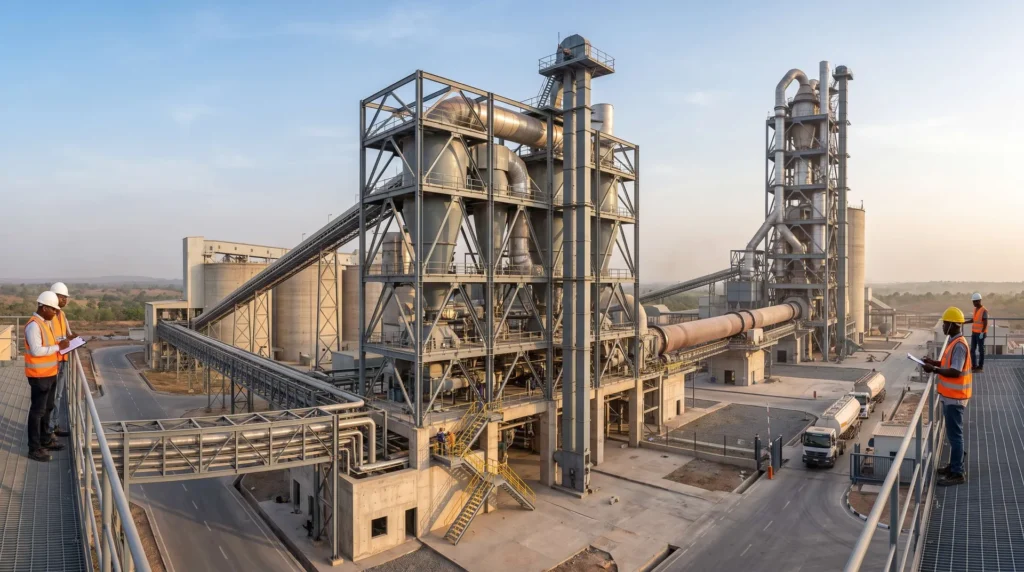
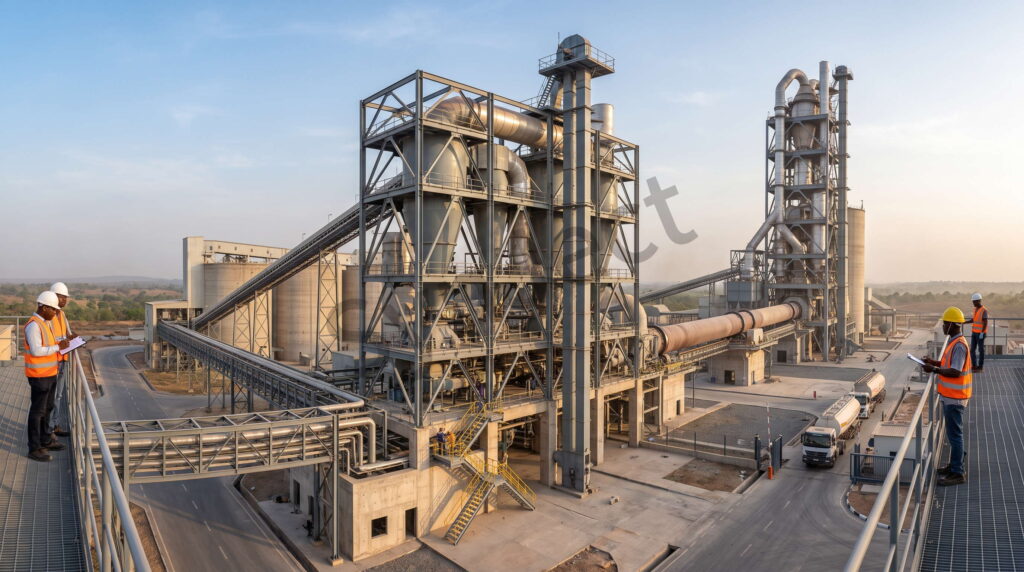
The Project, As Built
Completed works, structural details and the delivery team on site.


Client Testimonial
Feedback recorded from the client after handover.
Erecting steel 85 meters up in remote Nigeria leaves zero margin for error—an inch off and a 40-ton cyclone jams in mid-air. But Shijie’s steel aligned flawlessly: the vessels dropped straight onto bearing pads without a crowbar, and over 12,000 tons went up with zero cutting or welding aloft.
Frequently Asked Questions
Answers engineers ask before committing to a scope like this.
What is the scope of this Nigerian cement project?
An 85-metre-tall heavily braced preheater tower on roughly 12,500 tonnes of steel for a 6,000 TPD clinker line, supporting five stages of cyclone vessels, calciner ducts, exhaust lines above 400C and heavy dynamic machinery such as bucket elevators and ID fans.
Cyclone vessels are dropped into place from above. How tight is the tolerance?
Precision-milled column joints and continuous shop 3D laser-tracker verification hold beam spacing within plus or minus 2mm and full-height column drift within 20mm. Those numbers exist so 40-tonne vessels can be lowered cleanly into their seats instead of being jacked and shimmed on site.
ID fans create harmonic vibration that fatigues structures. How is that addressed?
Stiffened box-column cross-bracing was designed through dynamic FEA to shift the tower’s natural frequency away from the ID fan harmonic range. Keeping a structure out of resonance is the only real cure for cyclic fatigue – adding steel after the fact does not fix it.
Flue gas ducts run at 350-450C. What happens to the steel around them?
The frame accommodates cyclic duct expansion through its detailing rather than resisting it, so thermal movement does not accumulate into the connections that also carry the vessel loads.
Was any field rework needed during erection?
None – zero field reaming and zero torch cuts. Every splice is pre-drilled and bolted, which matters when the commissioning date is fixed by kiln ignition and any site correction becomes a schedule event.
Get Your 24-Hour BOQ and Cost Plan
See how much steel tonnage and ocean freight you can save before fabrication begins
Steel Weight Savings
1:1 Tekla 3D modeling optimizes beam-column ratios to eliminate redundant material costs.
Zero-Clash Code Verification
Checked against EN 1090 and local wind/seismic loads.
Engineer-to-Engineer Review
Verified by our lead engineers—Zero pushy sales calls, Just actionable data and factory price.
CE EN 1090-1•ISO 9001•ISO 14001•ISO 45001
Lead Engineers Online
🔒 100% Private and Secure, No Spam