
What a chemical facility does to a steel frame in its first year
Acid vapour, thermal cycling and a pipe rack that carries far more than its own weight. The structure is secondary to the process, but it fails first.
On a chemical site the structure is the least important thing in the room — until it corrodes, and then it becomes the only thing that matters.
SynJect builds steel structures for chemical facilities where pipe load, thermal movement and C5 exposure meet in the same frame.
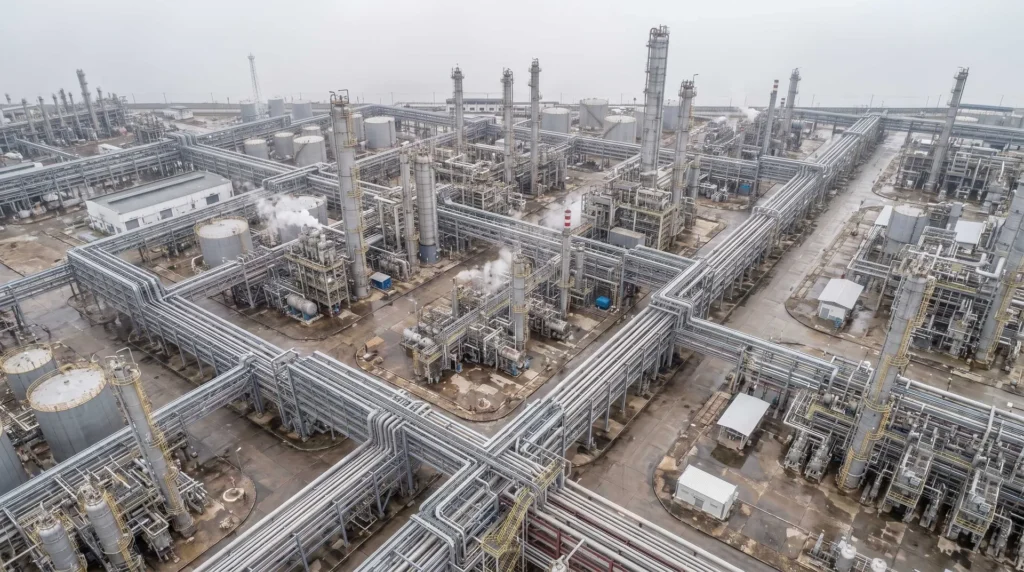
A pipe rack carries far more than its own weight: pipe self-weight, product, insulation, tracing and thermal movement, often 2–5 kN/m² of equivalent load, with lines that expand 100 mm or more between cold and operating conditions.
Add acid vapour at C5 and a blast zone that dictates where the structure may stand, and the frame becomes a process decision as much as a structural one.
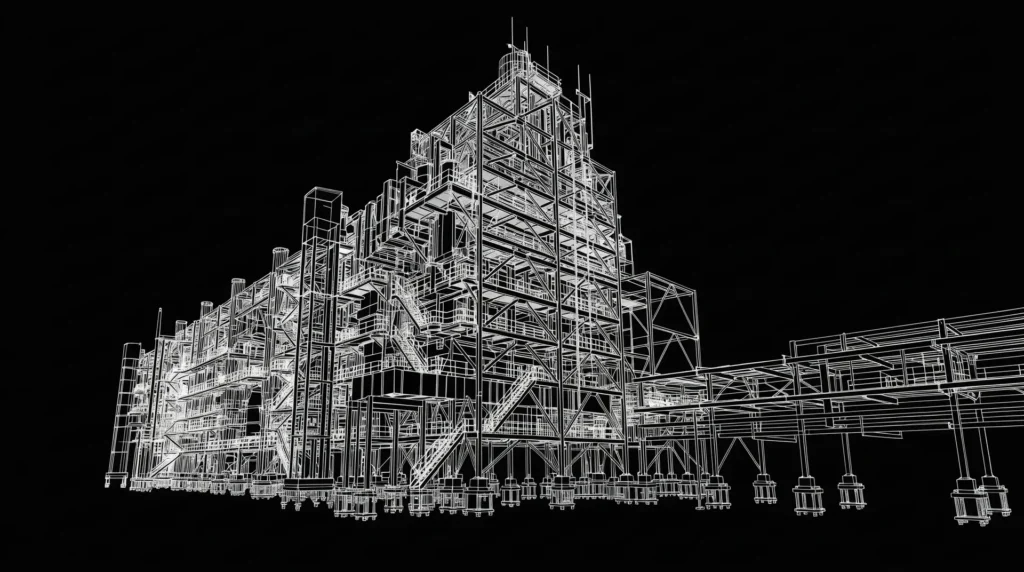 Structural model · Resources Steel Facilities
Pipe loads that include what is inside them
Racks are designed for pipe self-weight, product, insulation and tracing together, with thermal movement taken at the guides and stops rather than absorbed by the frame. A rack designed on empty pipe weight is a rack that bows in service.
Expansion given a direction to travel
A line that grows 100 mm between cold and hot will move the steel unless the loop and the anchor are placed correctly. We set guide and stop positions with the piping designer, so the frame carries the load and not the expansion.
C5 corrosion from the first drawing
Acid vapour attacks the same places as always — cut edges, bolt threads and the underside of horizontal members where condensate sits. Specification is C5 with sealed connections and stainless fasteners, not a site-applied topcoat.
Blast zone and drainage decide the layout
Where a structure may stand, and where a release would drain, are process decisions that constrain the structural grid. We coordinate the layout with the hazard study rather than fitting it afterwards.
Talk to an Engineer
Have drawings or a BOQ ready?
Steel Structures structural specification matrix
The values below are the design envelope we work to for each housing type. Final figures are fixed by your site wind and snow data, the equipment integrator’s layouts and the local building code.
| Parameter | Pipe rack | Process building | Tank farm | Pump house | Utility structure |
|---|---|---|---|---|---|
| Typical bay | 6–9 m | 8–12 m | 6–8 m | 6–9 m | 6–9 m |
| Pipe / equipment load | 2–5 kN/m² | per equipment | per tank | 1–3 kN/m² | 1–2 kN/m² |
| Thermal movement | 100 mm + | per line | per line | per line | per line |
| Corrosion class | C5 | C4–C5 | C5 | C4–C5 | C4 |
| Fire / blast | passive protection | blast resistant | passive protection | blast resistant | passive protection |
| Key detail | guides and stops | blast connections | bund wall interface | ventilation interface | access platforms |
Steel Structures questions, answered
The questions we get asked most by farm owners, integrators and EPC contractors before they commit to a design.
01What load does a pipe rack actually carry?
Pipe self-weight, product, insulation and tracing combined, typically 2-5 kN/m2 of equivalent load, plus the thermal movement of the lines. A rack designed on empty pipe weight will bow once the lines are commissioned.
02How is thermal expansion handled in a pipe rack?
By placing anchors, guides and expansion loops with the piping designer so the line moves in a defined direction. If that is not done, the frame absorbs the expansion and the structure fights the process.
03What corrosion class applies on a chemical site?
C5 for acid and vapour exposure, with sealed connections and stainless fasteners. The critical points are cut edges, bolt threads and the underside of horizontal members where condensate collects - a site-applied topcoat does not protect those.
04Can you design for a blast zone?
We coordinate the structural layout with the hazard study: where the structure may stand, which elements need blast resistance and how the frame is detailed at connections. Blast design is a system decision, not a coating.
05Do you fabricate to EN 13480 or ASME requirements?
The steel structure is designed and fabricated to EN 1090-2 with welding to ISO 3834, and we coordinate the interface with piping designed to EN 13480 or ASME B31.3, including support and guide locations.
06What documentation is required for a chemical plant?
Mill certificates with heat numbers, WPS and PQR records, NDT reports, coating thickness and holiday test reports, dimensional inspection and as-built drawings, compiled as an MDR for the operator.
07How are pipe-rack steelwork and foundation interfaces coordinated?
The piping, structural and foundation teams should agree on support locations, operating and installation loads, base plates and anchor-bolt details. The project scope should identify who issues and approves each interface drawing.
08How should maintenance access be included in a chemical-facility steel package?
Identify equipment requiring inspection, access routes and site restrictions during the design review. Coordinate platforms, clearance and protective coatings with the facility owner and the project safety requirements.
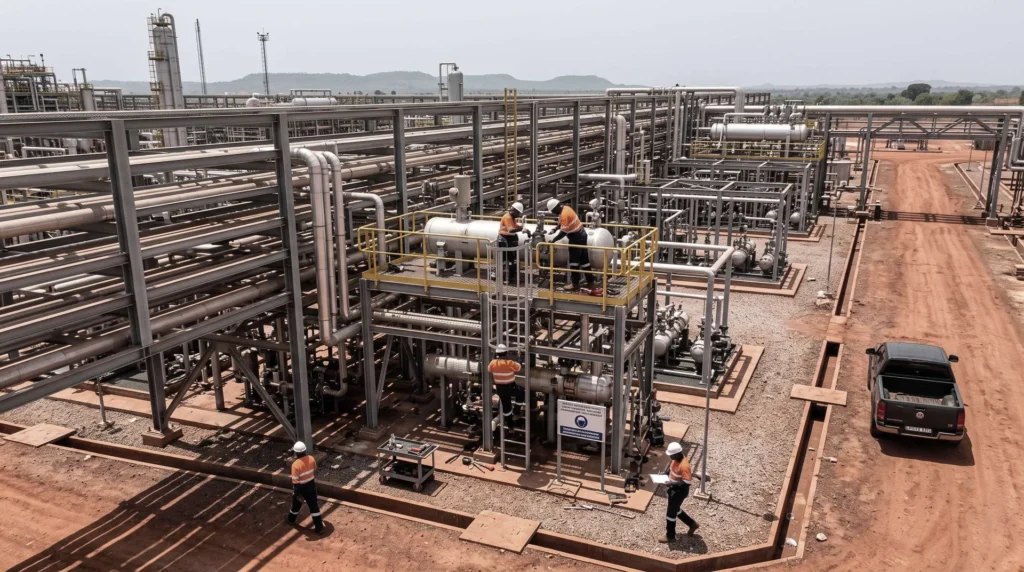
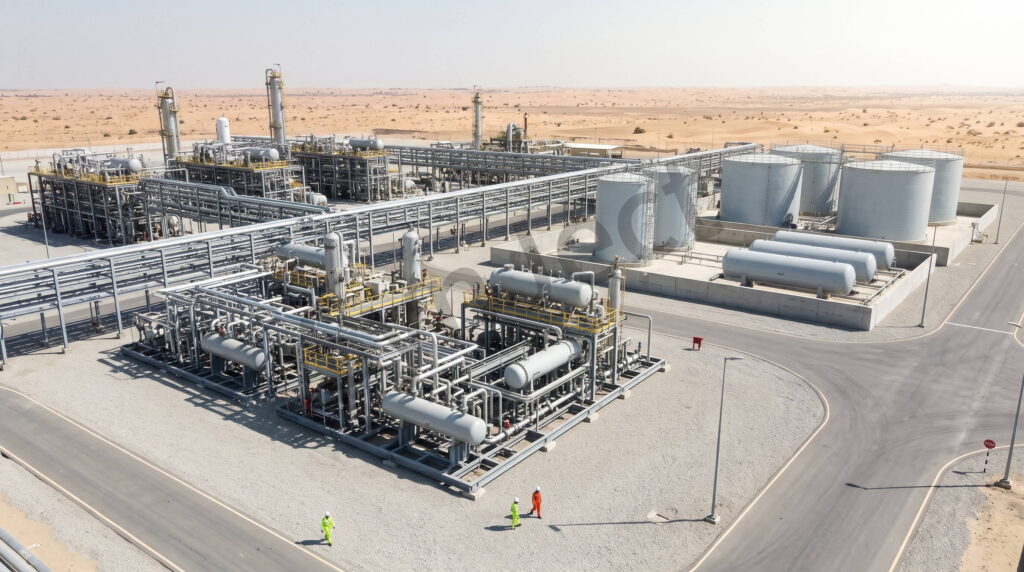
Chemical and resource projects in service
Pipe racks, process structures and tank farm steelwork we have fabricated and shipped.
Five tables in one PDF: clear spans and eave heights by housing type, equipment collateral loads, corrosion specification, ventilation parameters and the certification list.