±1.0 mm Modular Process Skids
Fabricated in Abu Dhabi. Saved 45 Days of desert site installation time.
Project Facts
The commercial and technical facts a contractor checks before requesting drawings.
| Industry | Onshore Modular Gas Processing & Separation |
|---|---|
| Location | Abu Dhabi, United Arab Emirates (UAE) |
| Project Scale | Up to 18m (L) × 6.5m (W) × 5.2m (H); up to 85 Tons/unit |
| Design & Execution | ADNOC Specs, ASME Sec. VIII Div.1, ASME B31.3, AWS D1.1 |
| Service Environment | +52°C extreme desert heat, fine silica sand abrasion, UV |
| Delivery Result | Saved 45 Days of desert site installation time |
| Our Scope | Heavy Skid Baseframes, Vessels & Pre-assembled Piping |
Project Overview
How the structure was engineered, fabricated and delivered in Abu Dhabi.
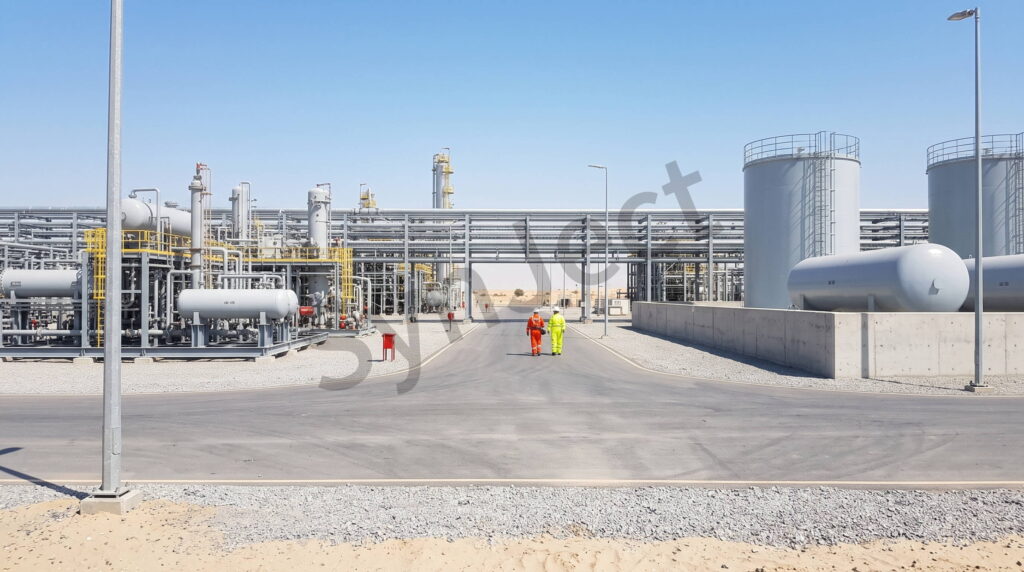
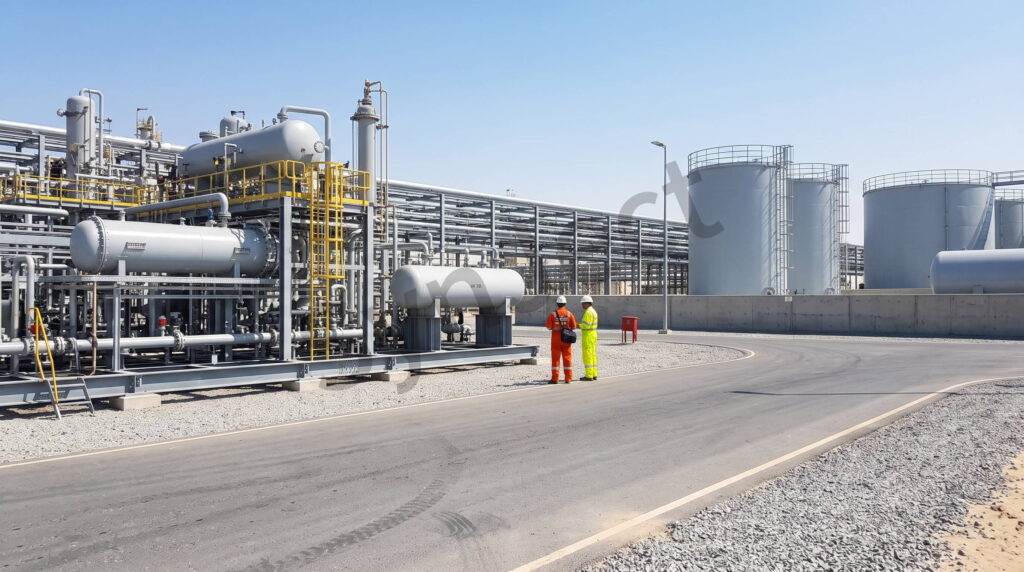
Located in the desert hinterland of Abu Dhabi (Habshan/Ruwais energy corridor), this critical upstream gas processing facility demanded rapid expansion under unforgiving conditions.
In the Middle Eastern desert, remote on-site fabrication faces extreme ambient heat exceeding +52°C, choking sandstorms, and exorbitant field labor and logistics costs.
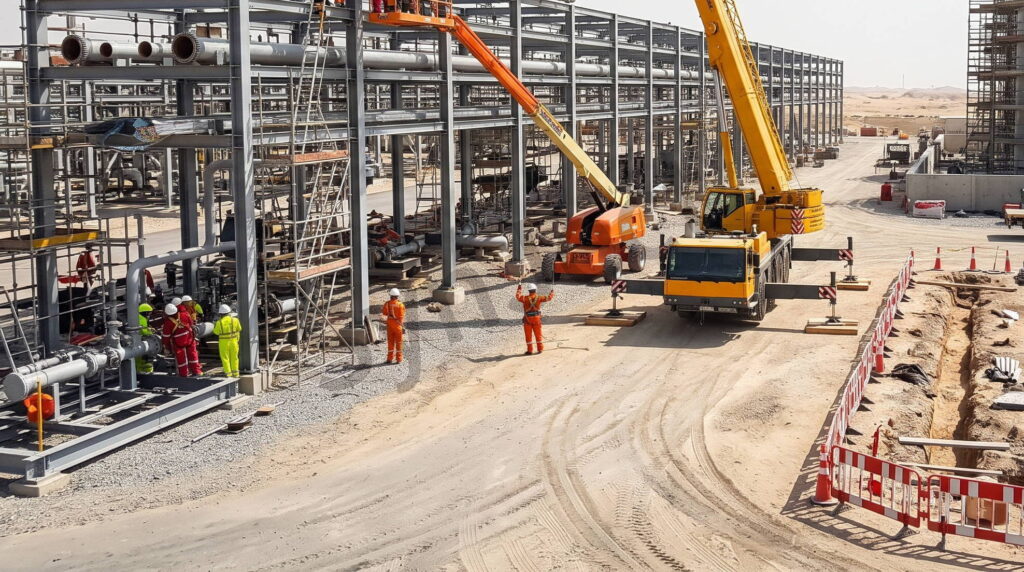
To compress the construction schedule and ensure absolute plant reliability, the EPC client adopted a comprehensive "Plug-and-Play" modularization strategy, requiring dozens of heavy process skids integrating high-pressure piping manifolds, ASME Section VIII separation vessels, shell-and-tube heat exchangers, and high-rigidity structural steel baseframes.
The project had to strictly adhere to ADNOC specifications, ASME B31.3, AWS D1.1, and ISO 12944 C5-I/C5-M marine-desert corrosion standards.
Four Decisions That Made It Work
Plug-and-Play Modular Integration
Fully integrated mechanical, piping, and vessel structures in-shop, enabling rapid flanged hookups and reducing on-site tie-in connections by over 80%.
Sub-Millimeter Baseframe Rigidity
Heavy H-beam and box girder skid base engineered to withstand multi-point lifting and desert transport twists without transferring deflection to sensitive
100% First-Pass NDT Dual Testing
Robotic submerged arc welding (SAW) and qualified low-hydrogen procedures ensured complete joint penetration (CJP) weldments were 100% free of porosity or
Desert-Resistant Heavy-Duty Coating
Sa 2.5 blast profile coupled with a three-coat inorganic zinc-rich and polyurethane system resilient against +50°C solar radiation and abrasive silica dust
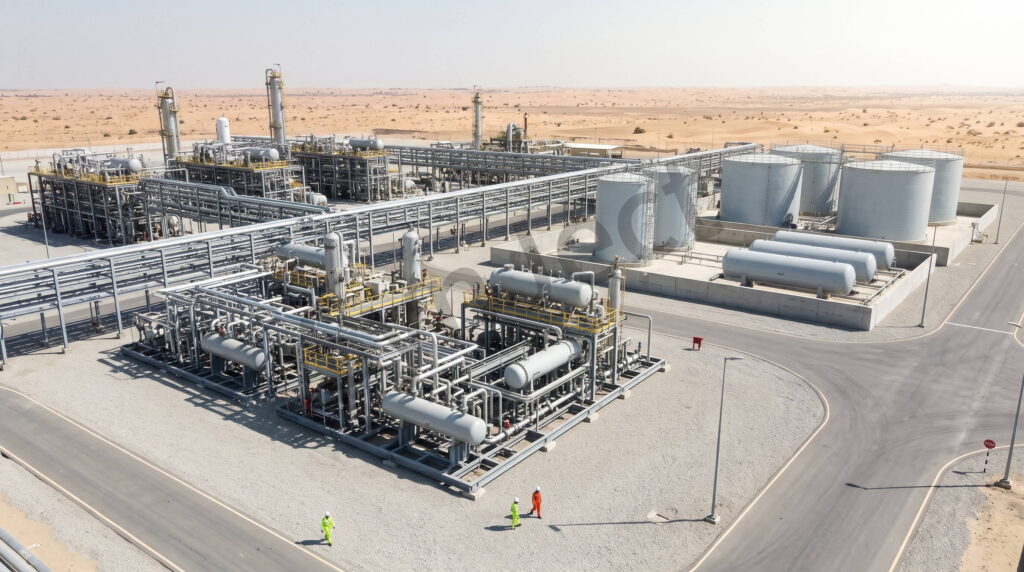
The Project, As Built
Completed works, structural details and the delivery team on site.


Client Testimonial
Feedback recorded from the client after handover.
In Abu Dhabi’s brutal desert, Shijie’s modular skids delivered surgical precision—zero field modifications, saving 45 days of high-risk site work!
Frequently Asked Questions
Answers engineers ask before committing to a scope like this.
What exactly are these skids and how large are they?
They are heavy plug-and-play process skids for an onshore gas processing facility in the Habshan-Ruwais corridor: baseframes up to 18 m long, 6.5 m wide and 5.2 m high, weighing up to 85 tonnes each, carrying high-pressure piping manifolds and ASME Section VIII Div.1 vessels on H-beam and box-girder baseframes.
An 85-tonne skid lifted at several points can twist the baseframe. How is that prevented?
The baseframe is modelled in 3D FEA for multi-point lifting and desert road transport, then fitted with temporary stiffening cradles and transport saddles for the journey. Rigidity is verified before shipment, so the piping interfaces arrive square and bolt up without field rework.
The piping inside a skid is extremely dense. How do you avoid clashes?
Every skid is modelled in full 3D CAD and Tekla against the pipe stress model, with clash detection run before fabrication. Critical interfaces are pre-checked with a shop laser tracker, so flanges and supports land within tolerance instead of being cut and re-welded on site.
What welding and inspection standard was applied for ADNOC?
Robotic submerged arc welding with qualified low-hydrogen procedures to AWS D1.1, with complete joint penetration verified by first-pass NDT. Hydro-testing is also completed in the shop, so the skid arrives tested rather than waiting for a site test package.
Can the coating survive +52°C, UV and windblown silica sand?
Yes. Steel is blast cleaned to Sa 2.5 with a 50-75 micron profile, then coated with an inorganic zinc-rich primer and polyurethane topcoat to ISO 12944 C5-M/C5-I, giving both abrasion resistance and UV stability in desert service.
Get Your 24-Hour BOQ and Cost Plan
See how much steel tonnage and ocean freight you can save before fabrication begins
Steel Weight Savings
1:1 Tekla 3D modeling optimizes beam-column ratios to eliminate redundant material costs.
Zero-Clash Code Verification
Checked against EN 1090 and local wind/seismic loads.
Engineer-to-Engineer Review
Verified by our lead engineers—Zero pushy sales calls, Just actionable data and factory price.
CE EN 1090-1•ISO 9001•ISO 14001•ISO 45001
Lead Engineers Online
🔒 100% Private and Secure, No Spam