- The design speed is the whole argument. Wind pressure scales with the square of velocity, so 240 kph against 150 kph is close to four times the load, not 1.6 times.
- NSCP 2015 has no wind zones. The Philippine code reads a basic speed from contour maps chosen by occupancy category, running from about 240 kph to roughly 320 kph on the hazardous-facility map.
- Uplift, not lateral drift, is the failure mode. Suction pulls the purlin off the rafter and can lift the column off its base plate, so the fixings carry the design.
- Sacrificial anodes do not protect a steel frame. They need a continuous electrolyte, which means immersed or buried steel. An atmospheric frame needs an ISO 12944 coating category.
- Bolted connections are accepted on preload, not torque. A torque figure quoted without the tightening method and lubrication assumption proves very little under EN 1090-2.
The premium buys a reversed load path and a denser fixing pattern at the roof edges. It also buys a coating system chosen by corrosivity category, and little of it shows up in the tonnage.
The short answer
A cyclone ready steel warehouse differs from a standard one in four places. The design wind speed comes from the correct map at the correct return period. The designer details the roof-to-frame connection for uplift, not for gravity. The check at the base plate looks at net tension rather than bearing. The specification names a corrosivity category instead of counting coats.
Everything else follows. Sections grow, but they grow as a consequence rather than as the design idea. None of the four items is exotic. Most of them settle on a single drawing sheet, and most of the cost sits in fixings and inspection rather than in tonnage.
First, the word
Southeast Asia does not get cyclones. It gets typhoons, because the events form in the northwest Pacific and the regional forecasting centres name them. The physics is the same. The basin is not, and the naming convention differs.
That distinction earns its keep when someone copies a specification from an Australian or Indian project. Buyers search for cyclone-ready because the phrase appears in export catalogues. A supplier who answers with typhoon data is worth more than one who repeats the term back. Explain why the two labels describe different basins and the answer gets better still.
What standard design actually means
No regional standard exists. Each country publishes its own loading code, and each code defines the design wind speed on a different basis.
One code gives a three-second gust at 10 m. Another gives a ten-minute mean. Others tie the value to an occupancy category, or to a wind zone, and the return periods differ as well. Two values that look comparable at 120 and 140 can describe very different loads once you unpack the averaging time.
A standard design is therefore one built to the local minimum. A cyclone-ready design is not a different code. It is the same code read at the correct site value, with the uplift case designed instead of assumed.
Reading the wind speed correctly
The Philippines shows why this is not a detail. NSCP 2015 dropped the old three wind zones and replaced them with contour maps. Which map you read depends on occupancy category. Essential facilities use one figure, hazardous facilities another, and ordinary buildings a third. Each figure carries its own mean recurrence interval.
On the map for hazardous facilities, contours run from roughly 240 kph on Panay to about 320 kph in northeast Luzon and Samar. The 150 kph figure that still circulates in older templates was the lowest zone of the previous edition. Against a 240 kph value, that is close to a factor of two in velocity, and wind pressure scales with the square of it. A floor became a ceiling somewhere in a template, and nobody checked.
| Country | Wind loading code | Basis of the design value | What it changes on a warehouse |
|---|---|---|---|
| Philippines | NSCP 2015, Section 207A | 3-second gust at 10 m, read from a contour map chosen by occupancy category; about 240–320 kph on the hazardous-facility map | Frame, bracing and anchorage across most of Luzon and the eastern seaboard |
| Vietnam | TCVN 2737 | Design pressure by wind zone, with the central coast exposed to typhoon and monsoon from opposing directions | Bracing and cladding fixings, not only member size |
| Malaysia | MS 1553:2002, with EN 1991-1-4 adopted through the MS EN series | 50-year basic speed of 33.5 m/s inland and 32.5 m/s on the peninsula perimeter, at 10 m | Sabah and Sarawak sit outside that map, so the figure cannot travel |
| Indonesia | SNI 1727 for actions, SNI 1729 for steel design | Regional wind speeds, materially lower than the Philippine values | The site value still governs, not a national average |
Why a national figure cannot travel
Malaysia looks calmer by comparison, and it is. The two codes are not interchangeable in the other direction either. A Malaysian 33.5 m/s is a ten-metre basic speed on a 50-year basis. A Philippine 240 kph is a three-second gust on a 700-year basis. Converting one into the other is a design task, not an arithmetic one.
Indonesia adds a trap of its own. SNI 1729 is the steel specification, and the wind actions sit in SNI 1727. Submittals that cite 1729 for wind loads cite the wrong document. A reviewer notices that in the first minute.
Where the extra steel actually goes
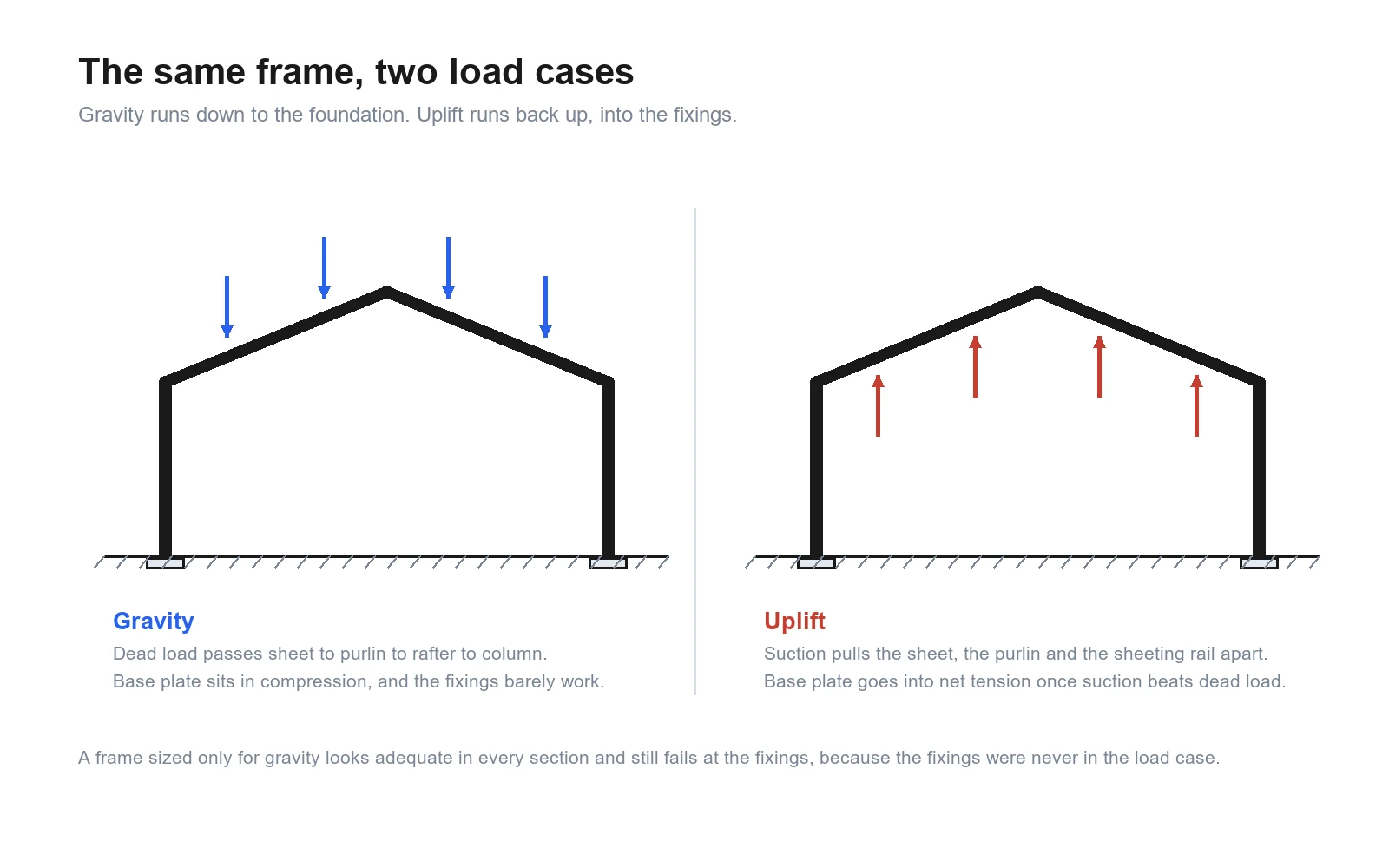
Wind pushes sideways and pulls upward. On a low-rise warehouse the roof is the part that leaves first, and it leaves vertically.
A gravity design carries load down through purlin, rafter, column and base plate. Uplift reverses part of that path. Suction on the roof pulls the purlin off the rafter, the rafter off the column, and the column off its foundation. A frame sized only for gravity can look adequate in every section. It still fails at the fixings, because the fixings were absent from the load case. So the sheet that decides the outcome is the connection detail, not the member schedule.
Four details carry most of the difference. Purlin cleats and their screws take the net uplift check, not the dead load sitting on them. The knee connection takes the reversed moment. The base plate takes net tension once suction exceeds the dead load of frame and roof. The anchor bolts then follow from that tension, with the edge distance and the concrete cone in view rather than the bolt alone.
Bracing belongs on the same list. A frame that relies on cladding for stability has no second line of defence once a sheet lifts. Tension rods or cable bracing in the end bays hold the first bay square. Continuity ties along the ridge and eaves keep a local failure local, instead of letting it run down the building.
The roof edge is not the roof
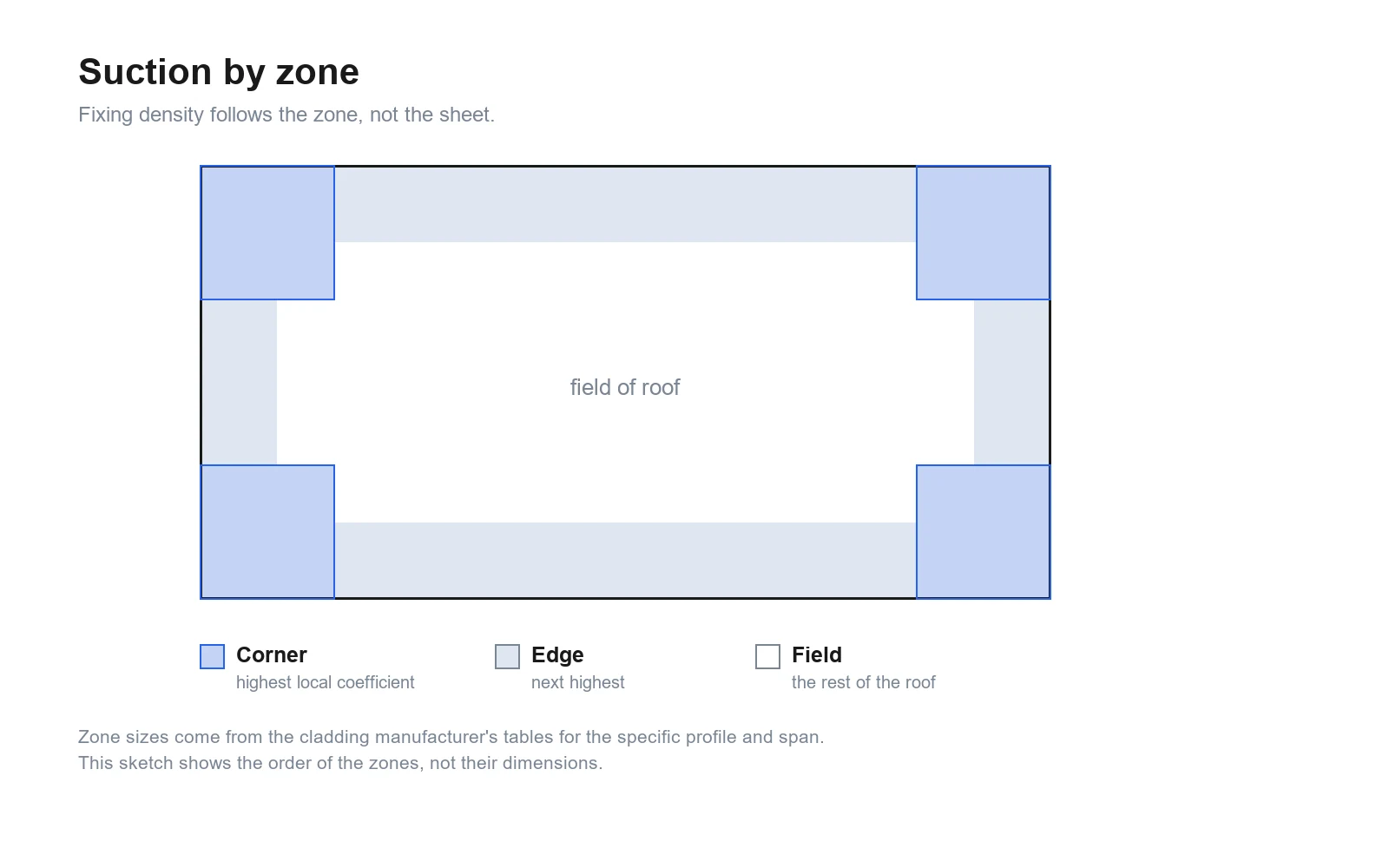
Suction is not uniform across a roof. It concentrates at corners, along edges and at the ridge. That is why every cladding manufacturer publishes fixing patterns by zone instead of a single screw spacing.
The practical consequence is that a cyclone-ready roof takes its fixing density from the zone map, not from average pressure. Corners take the highest local coefficient. Edges come next. The field of the roof takes the least. If a supplier quotes one screw spacing for the whole roof, the zone map has not been read. Fasteners at the corners are also the ones installed last, on a Friday, at the end of a shift, with a battery driver rather than a calibrated tool.
Two other items belong here. Roof sheeting needs a defined pull-over resistance for the washer, not just a screw gauge. And any opening that can be left open during a storm changes the internal pressure coefficient. A roller door, a louvre, an unfinished wall: each one can double the net uplift on the roof.
Corrosion, without the folklore
Coastal Southeast Asia is a corrosive place, and the honest specification for it is a category rather than a layer count.
ISO 12944 sorts the environment into corrosivity categories, and a coastal industrial site usually lands in C4 or C5-M. Choose the system to suit the category, and state a total dry film thickness in micrometres, measured on the blast-cleaned surface and checked before shipment. A primer, intermediate and topcoat schedule quoted without a corrosivity category is a schedule nobody can verify.
Hot-dip galvanising to ISO 1461 gets measured as coating mass or thickness, and it remains the right choice for members that are hard to repaint: purlins, bracing, base plates, anchor bolts. Duplex systems, galvanising plus paint, extend the interval before first maintenance. The paint then has to be compatible with the zinc rather than applied over it by hope.
One correction is worth stating plainly. Sacrificial anodes protect steel sitting in water or in soil, which is why they belong on tanks, pipelines and jetties. They do nothing for an atmospheric steel frame, because no continuous electrolyte closes the circuit. A specification offering anodes on a warehouse roof is describing the wrong technology.
Connections, inspection, and what to ask for
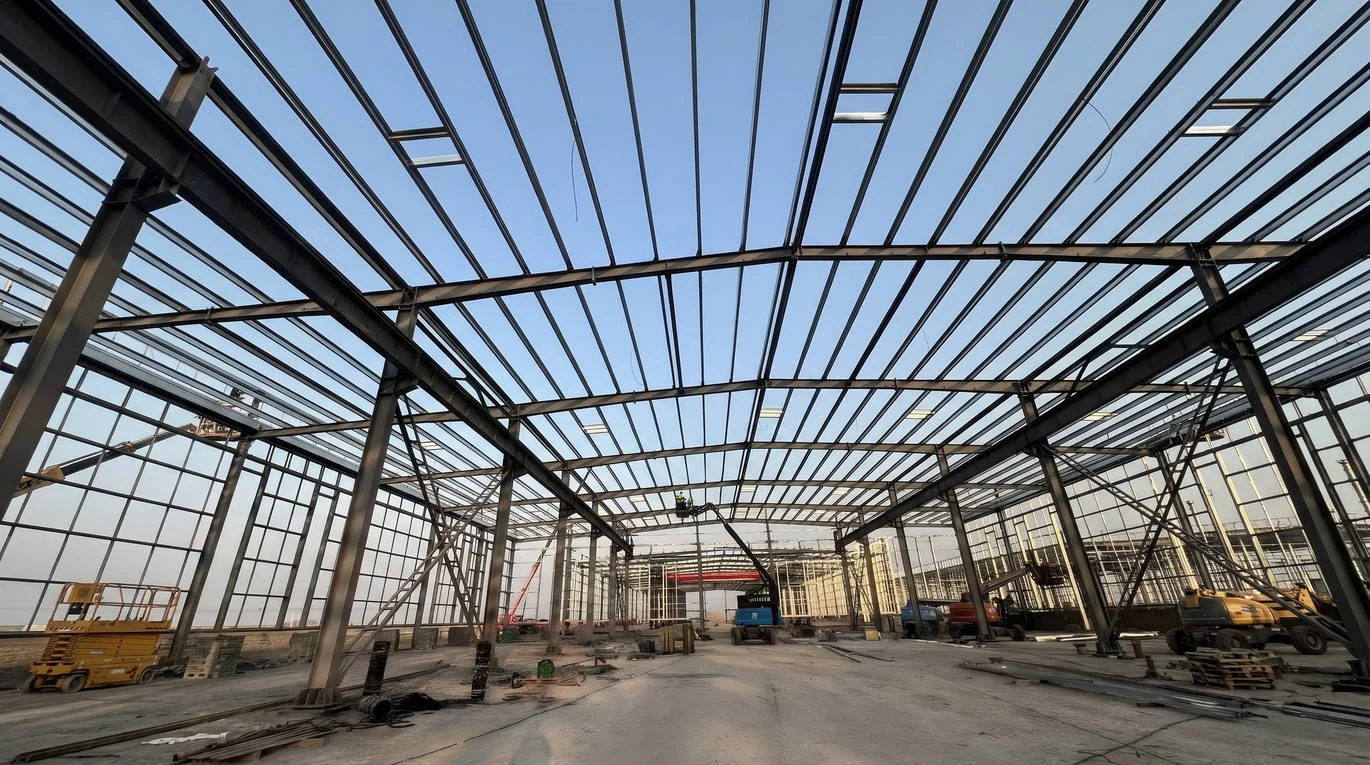
Execution class decides how much evidence the frame carries, and in Southeast Asia the project usually sets it rather than the country. EN 1090-2 organises that evidence: welding procedure specifications, welder qualification, bolting class, tolerance, and the extent of non-destructive testing.
Two habits matter more than the class number. First, acceptance of a preloaded connection is a matter of preload, verified per EN 14399 and the tightening method in EN 1090-2. A torque value quoted without the method and the lubrication assumption proves very little. Second, NDT covers a percentage of defined welds, chosen by execution class and weld type. A supplier who promises ultrasonic testing on every weld has either misread the standard or intends to charge for it.
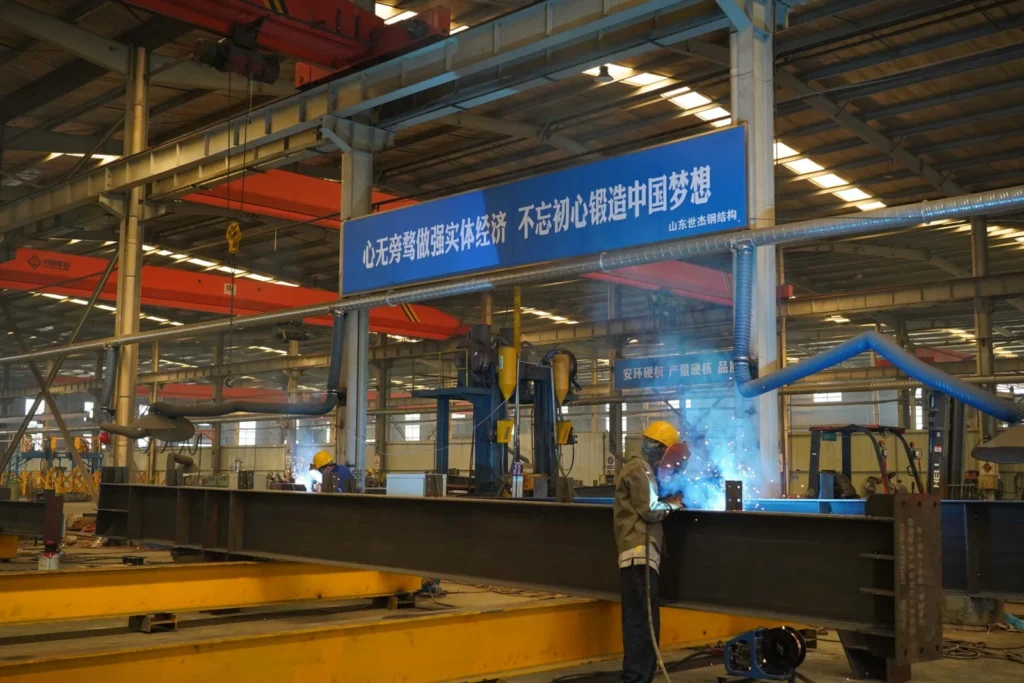
SynJect fabricates to EN 1090-2 EXC2 under CE certificate 2787-CPR-01627, with ISO 9001 (128224QJ0034R0S), ISO 14001 (128224E0234R0S) and ISO 45001 (128224S0217R0S) behind the management system. The scope is on our certificates page, and the execution class covered by the certificate is the number to check against your specification.
What the premium buys
The premium is real, and it is smaller than most buyers expect, because the tonnage is not where the money goes.
Extra steel in the rafters and columns is the visible part. The larger share sits in items that are easy to leave out of a quotation. Anchor bolts and their embedment, tie-down cleats, bracing, the denser fixing pattern at the edges, the higher coating thickness, and the inspection records that prove all of it.
That is also why two quotations for the same cyclone ready steel warehouse can differ by a wide margin and both be honest. They price different scopes. Unless the quotation states the uplift case and the coating category, the two numbers are not comparable. The comparison that matters is not cost per tonne. It is cost per square metre, with the uplift case, the coating category and the NDT extent written down.
Frequently asked questions
Is cyclone-ready the same as typhoon-resistant?
Functionally yes, geographically no. Southeast Asia’s events are typhoons, formed in the northwest Pacific. Cyclone is the term used in the Indian Ocean and around Australia. The engineering belongs to the same family of wind loading. The design value and the code it comes from do not.
Which wind speed should a Philippine warehouse be designed to?
Read it from the NSCP 2015 contour map for the project’s occupancy category, at the site. On the hazardous-facility map the contours run from about 240 kph to roughly 320 kph, so a single national figure is the wrong starting point. The older 150 kph zone value belongs to a superseded edition.
Why does uplift matter more than the wind pushing sideways?
Because a low-rise warehouse has a large roof and a small vertical face. Suction on the roof removes the purlins from the rafters and can lift the columns off their base plates. The lateral case mostly stresses bracing that is already there, so the failure mode is vertical.
Do sacrificial anodes protect a cyclone ready steel warehouse?
No. Anodes work where steel sits in water or in soil and a continuous electrolyte closes the circuit. An atmospheric frame needs a coating system chosen to an ISO 12944 corrosivity category, with galvanising to ISO 1461 where repainting is impractical.
What should a buyer ask for before comparing quotations?
Ask for the design wind speed with its source map and return period, the uplift case with the internal pressure assumption, the coating system with its corrosivity category and dry film thickness, the execution class with the NDT extent, and the anchor bolt design. Two quotes that answer all five can be compared. Two that answer only the first cannot.
Notes on sources and further reading
The design values quoted above come from the national loading codes rather than from catalogues. NSCP 2015 is published in the Philippines and administered with building permit approval through DPWH, and the EN 1090 and ISO 12944 families can be traced through CEN-CENELEC. Where a figure is given as a range, it describes the spread across a map or a zone, not a value a designer may pick freely: read the number at the site, for the project’s occupancy class and return period, and let the qualified person confirm it.
If a warehouse package is still open, send the site coordinates, the racking layout and the governing local code to our engineering team and we will come back on the wind case, the uplift path and a material take-off: request a quote.
Vanden is Head of International Department at Shijie Heavy Industry Co., Ltd., the steel fabricator behind the SynJect export brand.
SynJect is the export brand of Shandong Shijie Heavy Industry Co., Ltd., fabricating structural steel to EN 1090-2 EXC2 under CE certificate 2787-CPR-01627. Certification scope, validity and the execution classes covered must be confirmed against the certificate itself before tender submission. Design wind speeds in this article are cited to show how the national codes differ; they are not a substitute for a site-specific structural calculation.