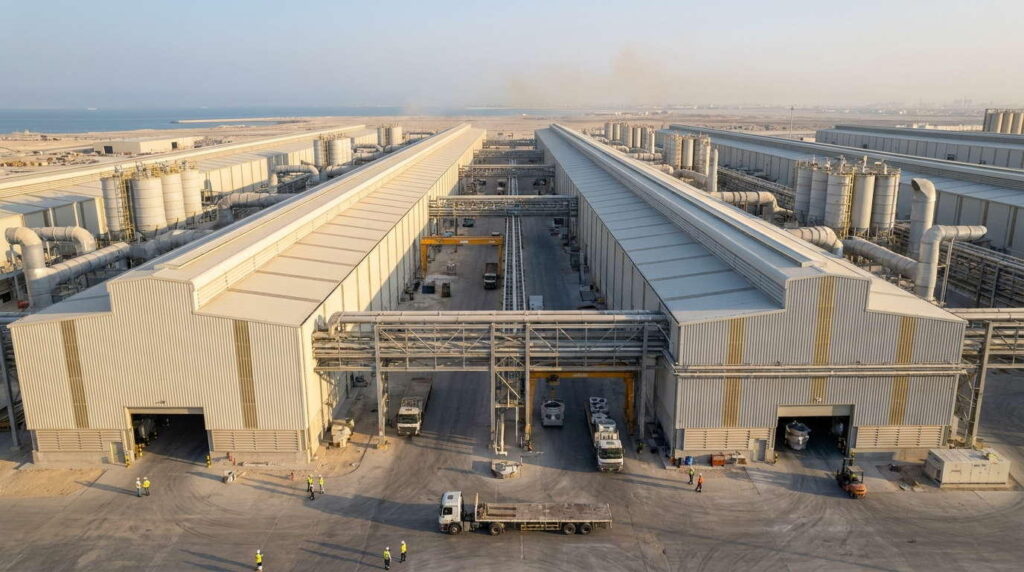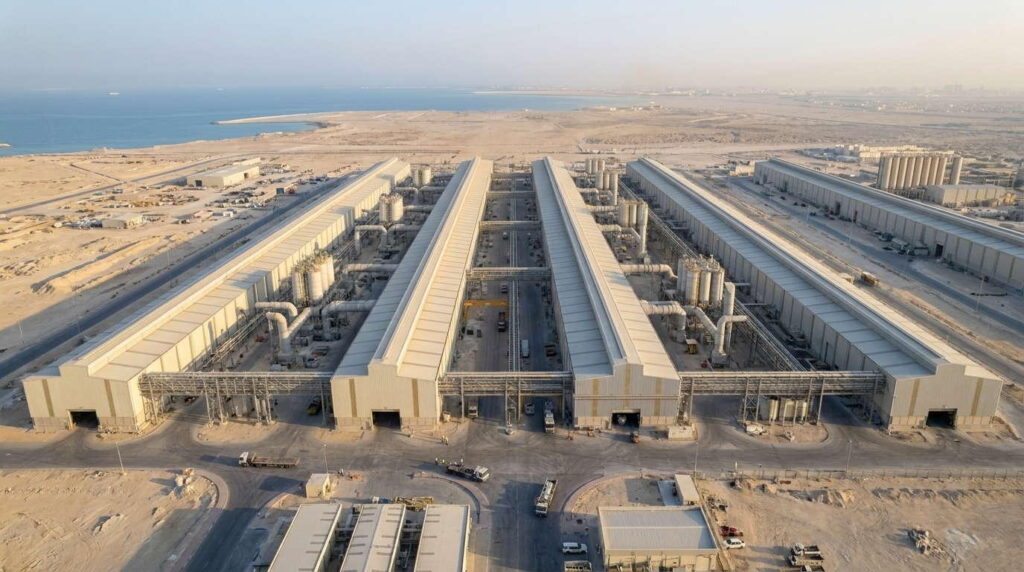
1,200m Ultra-Long Aluminum Smelting Potline Complex
Fabricated in Coastal Smelting & Industrial Corridor. C5-M coating, shop assembly. Ready for "First Hot Metal" 25 Days Ahead of Deadline.
Project Facts
The commercial and technical facts a contractor checks before requesting drawings.
| Industry | World-Scale Primary Aluminum Smelter Potlines |
|---|---|
| Project Scale | 1,200m Length; ~190,000 sqm GFA (~26,500 Tons Steel) |
| Design & Execution | Span & straightness deviation locked within $\le \pm 1.0\text{ mm}$ |
| Service Environment | ISO 12944 C5-M (Marine-Industrial High Fluoride) |
| Delivery Result | Ready for "First Hot Metal" 25 Days Ahead of Deadline |
| Location | Coastal Smelting & Industrial Corridor, Bahrain |
| Our Scope | Fabrication, C5-M coating, shop assembly and delivery |
Project Overview
How the structure was engineered, fabricated and delivered in Coastal Smelting & Industrial Corridor.
Constructing a world-scale aluminum smelting potline along the coastal desert of Bahrain is a high-stakes engineering endeavor. Spanning over 1.2 kilometers linearly, these twin potroom workshops house hundreds of reduction cells operating continuously at nearly 1,000° C , flanked by massive direct-current (DC) busbars carrying over 400 kA.
For the EPC construction director, the primary operational fear was crane rail track misalignment and thermal expansion binding.
Overhead Pot Tending Assemblies (PTAs)—massive, multimillion-dollar specialized cranes—must travel the entire 1,200-meter length around the clock to tap molten metal and replace carbon anodes. If the building’s heavy crane girders twisted by just 2 millimeters, or if thermal expansion joints jammed during Bahrain's blistering +50° C summer heatwaves, the PTA crane wheels would gnaw the rails or seize completely.
Freezing an electrolytic pot due to an inoperable crane can ruin an entire potline, costing tens of millions of dollars.

Four Decisions That Made It Work
Sub-Millimeter PTA Crane Gantry Precision
Machined all heavy crane girder bearing seats on CNC floor-type milling centers, holding continuous track elevation and span tolerances within $\pm 1.0\tex
Thermal-Expansion Sliding Relief Joints
Integrated low-friction PTFE sliding shoe bearings and slotted bolted splices across building sections, releasing $\pm 180\text{mm}$ of cumulative summer-t
High-Airflow Natural Ventilation Roof Moni
Fabricated continuous aerodynamic ridge ventilators across the entire 1,200m roofline, discharging immense radiant heat from reduction cells without extern
C5-M Marine-Fluoride Resistant Coating
Grit-blasted to Sa 2.5 with heavy-build epoxy micaceous iron and polyurethane topcoats, resisting scorching sun, maritime salt fog, and acidic fluoride dus
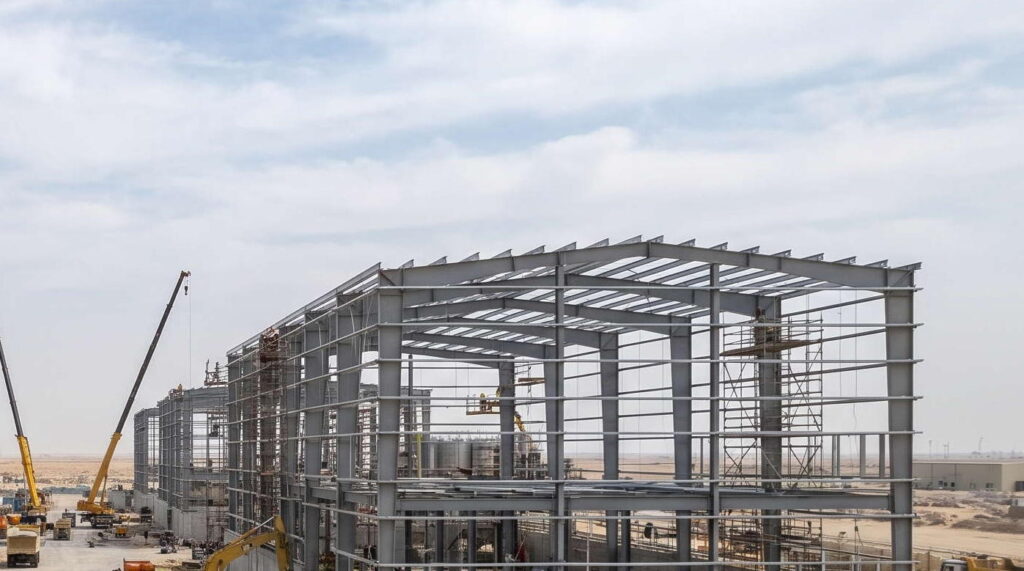
The Project, As Built
Completed works, structural details and the delivery team on site.


Client Testimonial
Feedback recorded from the client after handover.
Along a 1.2km potline under +50°C heat, jammed crane rails mean frozen pots. Shijie aligned the entire track within 1mm: our PTA crane ran smooth as ice with zero field cuts, delivering 25 days early.
Frequently Asked Questions
Answers engineers ask before committing to a scope like this.
What is the scope of this Bahraini smelter complex?
Twin potroom workshops running 1,200 metres linearly, about 190,000 sqm of floor area on roughly 26,500 tons of steel, housing hundreds of reduction cells operating continuously near 1,000C alongside DC busbars carrying over 400 kA.
Pot tending assemblies are multi-million-dollar cranes. How precise is the rail?
Crane girder bearing seats are machined on CNC floor-type milling centres, holding continuous track elevation and span tolerance within plus or minus 1.0mm. Misalignment at that scale causes rail and wheel wear, and eventually rail binding on a crane that must travel the full kilometre.
A 1,200m building moves with the seasons. How is that handled?
Low-friction PTFE sliding shoe bearings combined with slotted bolted splices release roughly plus or minus 180mm of cumulative summer-to-winter thermal drift between building sections, without transferring that movement into the crane girders.
Reduction cells radiate massive heat. Is mechanical ventilation needed?
The roofline carries continuous high-capacity aerodynamic ridge monitors delivering over 40 air changes per hour by natural buoyancy. Process heat leaves through the roof instead of being trapped, which keeps the working environment viable without power-hungry extract fans.
Coastal desert air is both humid and saline. What protects 26,500 tons of steel?
An ISO 12944 C5-M marine-industrial coating system, applied after blast cleaning, suited to a site where salt-laden air combines with industrial emissions from the smelter itself.
Get Your 24-Hour BOQ and Cost Plan
See how much steel tonnage and ocean freight you can save before fabrication begins
Steel Weight Savings
1:1 Tekla 3D modeling optimizes beam-column ratios to eliminate redundant material costs.
Zero-Clash Code Verification
Checked against EN 1090 and local wind/seismic loads.
Engineer-to-Engineer Review
Verified by our lead engineers—Zero pushy sales calls, Just actionable data and factory price.
CE EN 1090-1•ISO 9001•ISO 14001•ISO 45001
Lead Engineers Online
🔒 100% Private and Secure, No Spam