150 MW Utility-Scale Solar Mounting Structures
Fabricated in Negev Desert. Zn-Al-Mg coating, bolted trial assembly. Handover 30 Days Ahead of Schedule.
Project Facts
The commercial and technical facts a contractor checks before requesting drawings.
| Industry | Utility-Scale Solar Mountings |
|---|---|
| Location | Negev Desert, Southern Israel |
| Project Scale | 150 MW Direct Current Capacity |
| Service Environment | Zinc-Aluminum-Magnesium (Zn-Al-Mg) |
| Delivery Result | Handover 30 Days Ahead of Schedule |
| Steel Material | High-Yield Cold-Formed Steel |
| Our Scope | Fabrication, Zn-Al-Mg coating, bolted trial assembly and delivery |
Project Overview
How the structure was engineered, fabricated and delivered in Negev Desert.
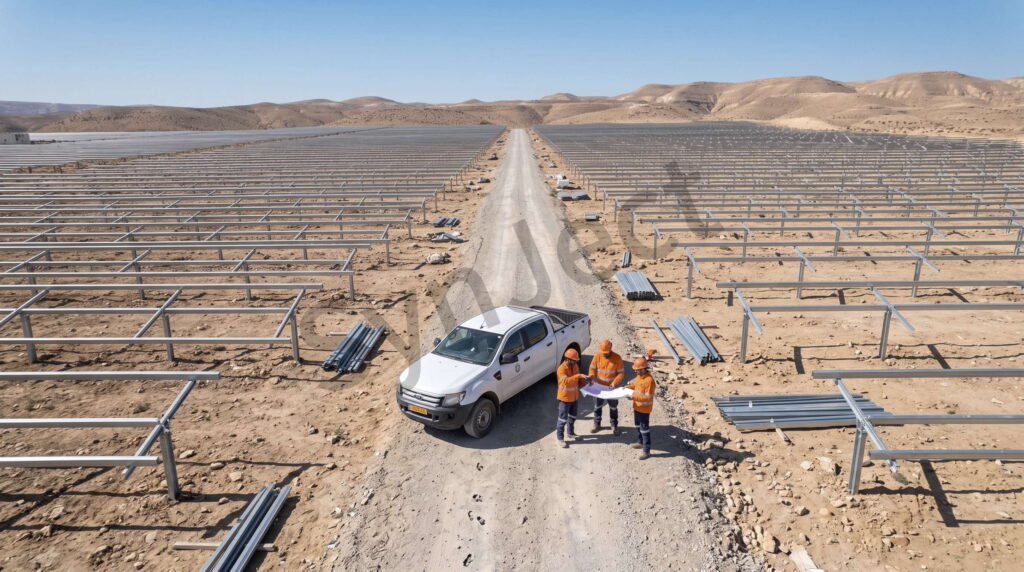
Set across the rocky terrain of the Negev Desert, this 150 MW utility-scale solar facility supplies clean electricity to Israel's national transmission network. Building expansive photovoltaic tracker and fixed-tilt arrays across arid desert topography introduces challenging structural constraints. Plant asset managers and EPC contractors focus heavily on long-term mechanical reliability and cost containment.
They face three recurring field challenges: resisting high seasonal desert wind shears and thermal uplift without structural deformation, preventing underground galvanic soil corrosion and airborne sand abrasion over a thirty-year operating life, and avoiding installation delays across vast, uneven ground. Shijie Heavy Industry addressed these engineering demands by delivering a robust cold-formed steel mounting system.
We utilized high-strength structural steel profiles coated with a specialized zinc-aluminum-magnesium alloy, providing self-healing corrosion resistance superior to standard galvanizing. Rammed C-channel posts were engineered with variable embedment depths to achieve solid mechanical anchoring in stony desert soils without concrete foundations.
High-precision factory punching enabled rapid field bolting across miles of continuous tables. Completing mounting deliveries 30 days ahead of schedule allowed electrical installation teams to string modules smoothly.

Four Decisions That Made It Work
150 MW Utility-Scale Solar Mounting Struct
Desert Wind Resilience and Zinc-Aluminum-Magnesium Durability
Desert Wind Uplift Resistance
Braced mounting tables are engineered with reinforced purlin connectors and diagonal struts to safely counter severe gust-induced torsion.
Self-Healing Alloy Shield
High-performance zinc-aluminum-magnesium alloy coating protects punched holes and cut edges against corrosive desert soils and sandstorms.
Concrete-Free Fast Foundation
Heavy-gauge rammed C-posts eliminate concrete curing, accelerating pile driving across rocky, unpaved terrain without water usage.
The Project, As Built
Completed works, structural details and the delivery team on site.


Client Testimonial
Feedback recorded from the client after handover.

In the Negev Desert, harsh sun, rocky soil, and fierce winds quickly ruin cheap mounting brackets. Shijie’s zinc-aluminum-magnesium coating was uniform and spall-free, ensuring excellent protection against soil salinity.
Frequently Asked Questions
Answers engineers ask before committing to a scope like this.
What was delivered for this Israeli solar plant?
Mounting structures for a 150 MW DC utility-scale photovoltaic facility in the Negev Desert, using high-yield cold-formed steel with zinc-aluminium-magnesium coating on direct-rammed C-post piles.
Desert winds and thermal updrafts twist mounting tables. How is that resisted?
Braced tables with reinforced purlin connectors and diagonal struts distribute aerodynamic uplift into the foundation, engineered for 160 km/h desert gusts. Uplift, not downward load, governs solar structures in open terrain.
Soil in the Negev is aggressive and sand abrasion is constant. What protects the posts?
A thick Zn-Al-Mg surface treatment that forms a dense oxide barrier, including at punched holes, and shields the section below grade where galvanic soil corrosion attacks conventional coatings over a 30-year life.
Why rammed C-posts instead of concrete foundations?
Concrete needs water, curing time and access for a mixer across rocky unpaved terrain. Direct-rammed posts eliminate all three, which is what makes it possible to install across undulating ground at utility scale.
How does the system cope with uneven terrain?
Slotted mounting holes are machined on factory lines, so bolt installation absorbs the slope variation without field drilling or cutting. Handover came 30 days ahead of schedule.
Get Your 24-Hour BOQ and Cost Plan
See how much steel tonnage and ocean freight you can save before fabrication begins
Steel Weight Savings
1:1 Tekla 3D modeling optimizes beam-column ratios to eliminate redundant material costs.
Zero-Clash Code Verification
Checked against EN 1090 and local wind/seismic loads.
Engineer-to-Engineer Review
Verified by our lead engineers—Zero pushy sales calls, Just actionable data and factory price.
CE EN 1090-1•ISO 9001•ISO 14001•ISO 45001
Lead Engineers Online
🔒 100% Private and Secure, No Spam