80m Clear-Span Arch Space Truss Hangar
Fabricated in Clark Freeport Zone. Hot-dip galvanizing, shop assembly.
Données du projet
The commercial and technical facts a contractor checks before requesting drawings.
| Industry | Commercial Aviation MRO Hub |
|---|---|
| Location | Clark Freeport Zone, Philippines |
| Construction Type | Ground-Supported Arch Space Trusses |
| Project Scale | 80m Clear Arch Span × 75m Depth |
| Service Environment | Duplex Galvanizing & Marine Epoxy |
| Feature | Integrated Aircraft Tail Notch |
| Our Scope | Fabrication, hot-dip galvanizing, shop assembly and delivery |
Présentation du projet
How the structure was engineered, fabricated and delivered in Clark Freeport Zone.
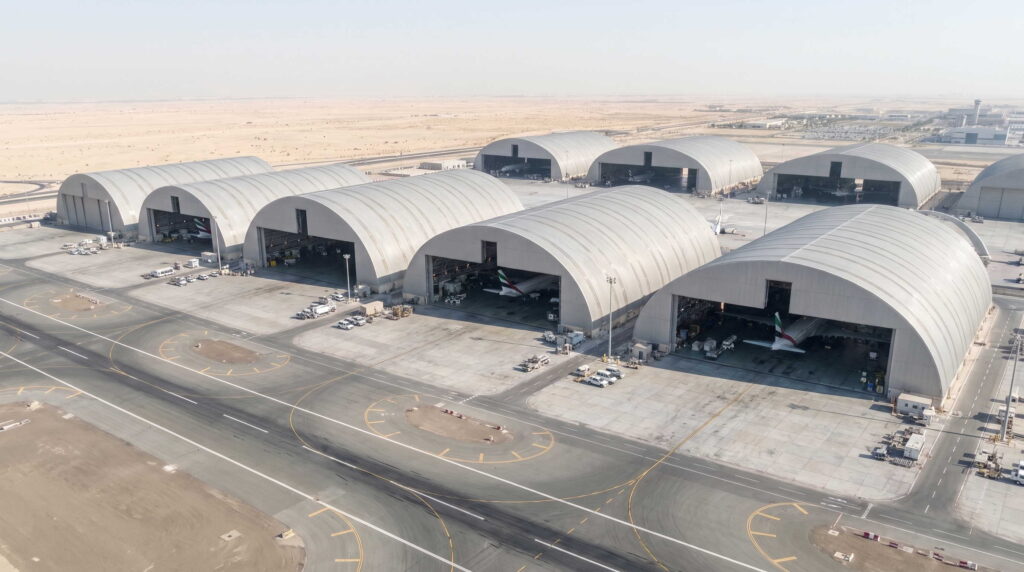
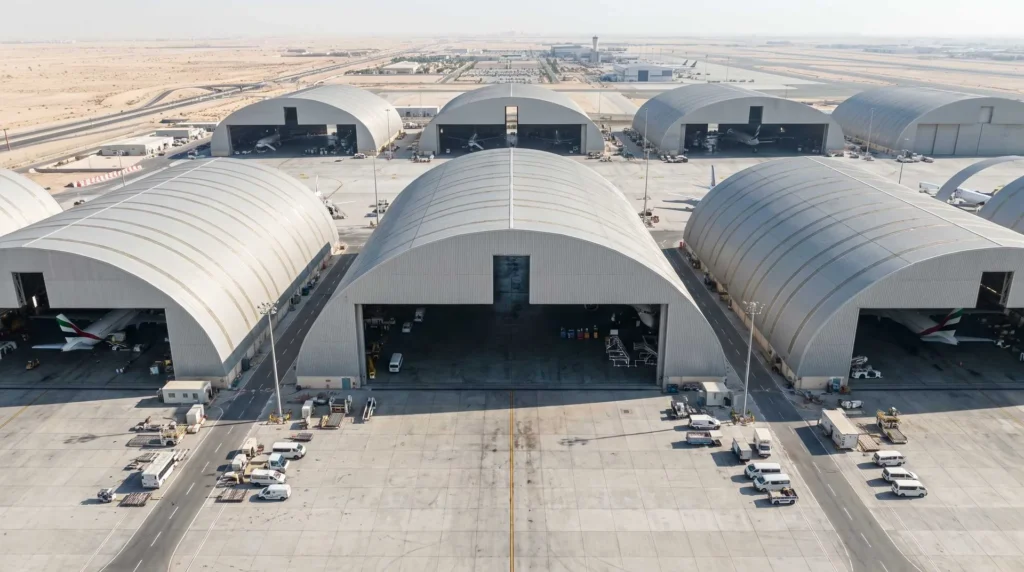
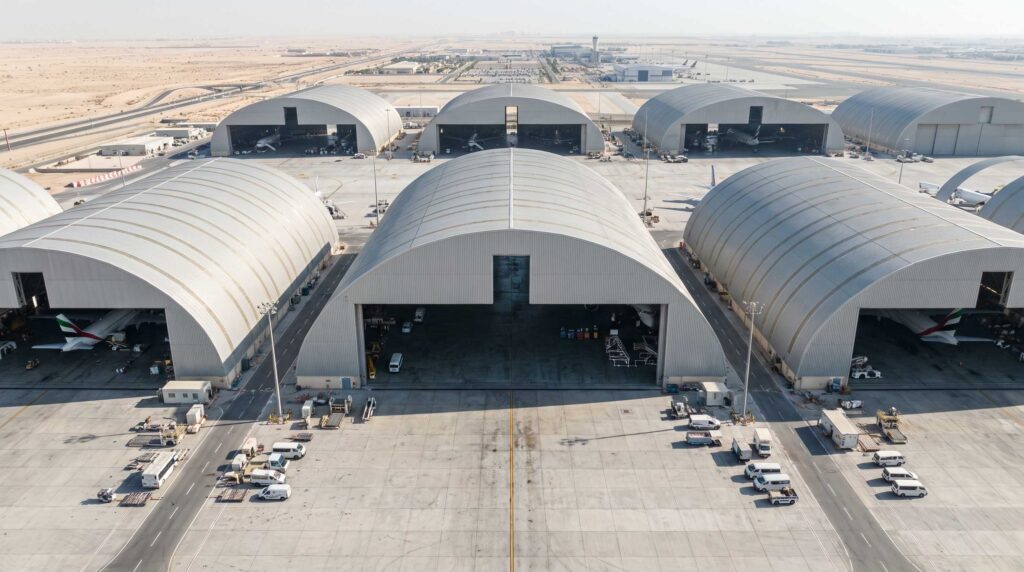
In commercial aviation MRO infrastructure, schedule slippage causes severe aircraft grounding losses and costly liquidated damages. For this wide-body servicing facility in Clark, the contractor faced a strict goal: delivering an 80-meter column-free hangar before the monsoon under Category 5 typhoons (> 270 km/h) and coastal salinity.
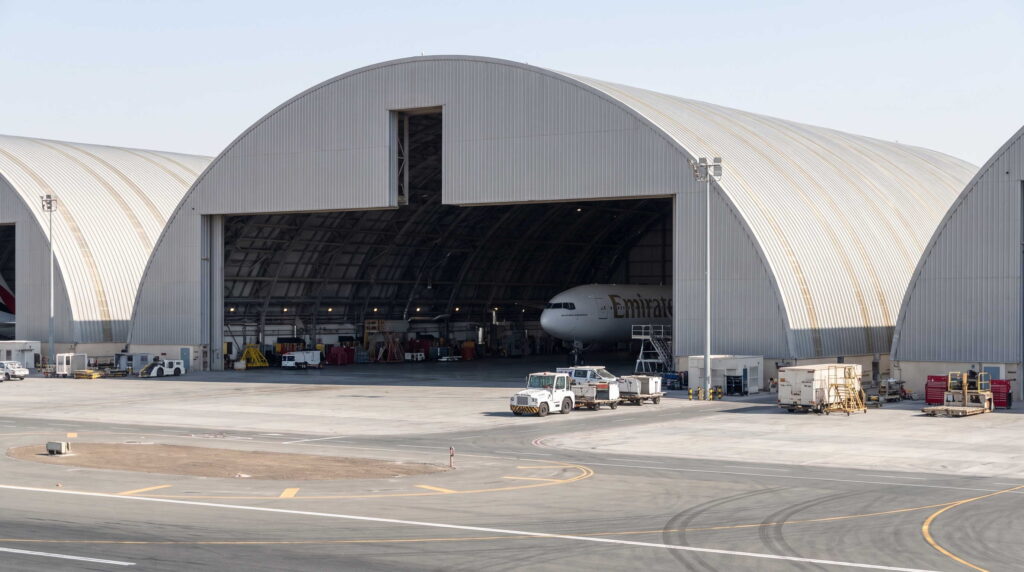
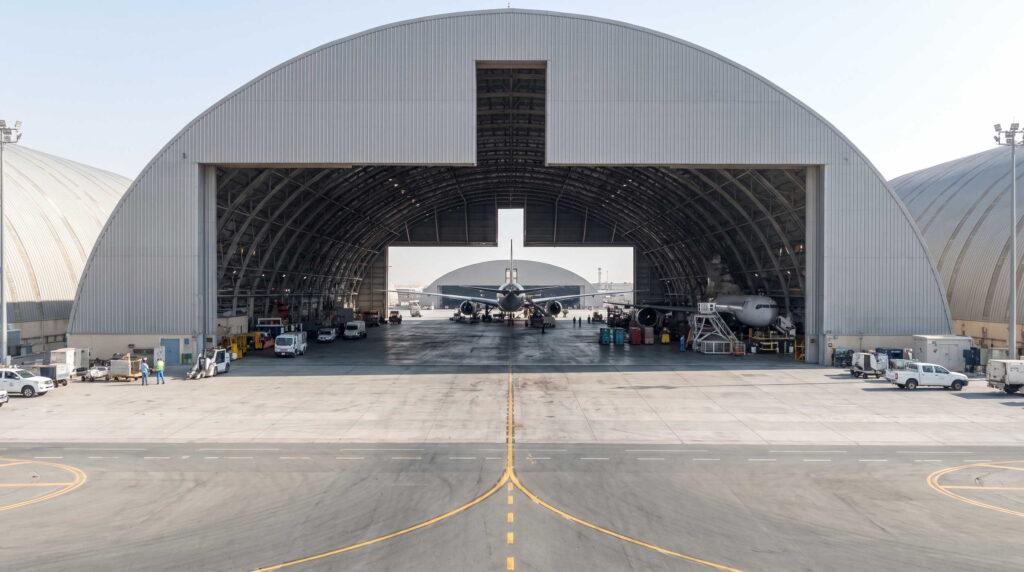
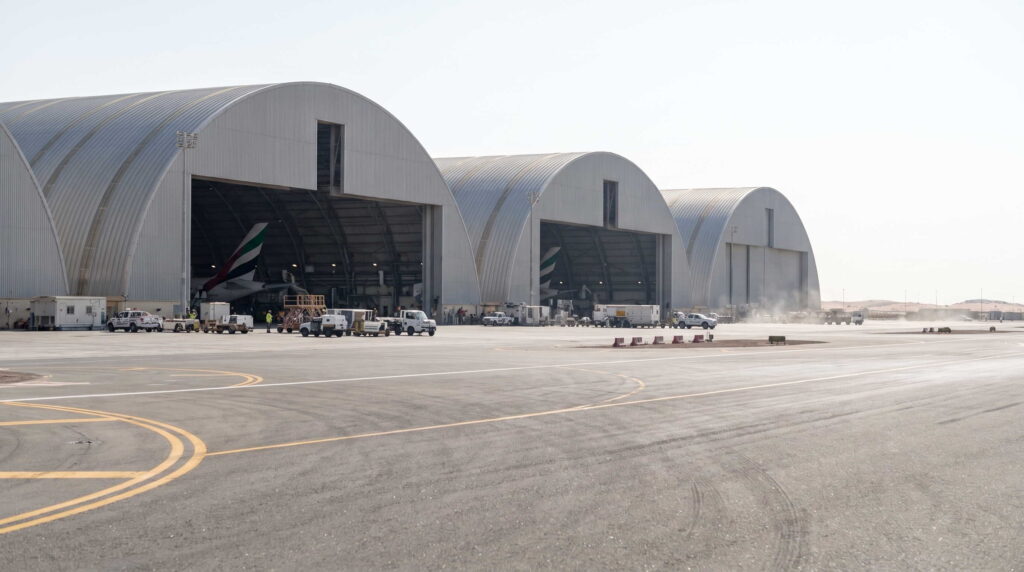
Standard boxy hangars act as blunt barriers against violent wind suction. To counter this, the facility adopted ground-supported curved arch space trusses with an integrated tail notch.
The curved geometry guides typhoon gusts smoothly over the building, slashing uplift forces. The tail pocket accommodates stabilizers without elevating overall eaves, minimizing frontal windage.
Dimensions, codes, inspection rates and schedule outcomes for this project are recorded in the Project Facts table above, so they can be checked before an enquiry is issued.
Quatre décisions décisives
Aerodynamic Arch Profile
Grounded arch space trusses guide typhoon gusts smoothly across the roof, slashing wind uplift.
Tail-Notch Wind Reduction
The specialized roof notch accommodates aircraft stabilizers while keeping main eaves low to reduce windage.
Corrosion Strategy
hot-dip galvanizing selected for the service environment recorded in the Project Facts.
Connection Design
100% pre-drilled bolted connections, trialled in the shop, so the frame goes up without site welding.
Le projet réalisé
Completed works, structural details and the delivery team on site.


Témoignage du client
Feedback recorded from the client after handover.
Erecting an 80-meter clear-span hangar in the Philippine typhoon belt required superior aerodynamic efficiency. Boxy hangars act like massive sails in Category 5 storms. Shijie Heavy Industry fabricated an outstanding curved arch space truss structure with an integrated tail notch.
Questions fréquentes
Answers engineers ask before committing to a scope like this.
What was built at Clark Freeport for this MRO operator?
An 80-metre column-free clear-span maintenance hangar for wide-body aircraft, built as a double-layer space frame with CNC forged bolted ball joints so the entire enclosure goes up without field cutting, drilling or welding.
The Philippines sits in the typhoon belt and the Ring of Fire. How is that designed for?
To NSCP 2015 Zone 4 with a design wind speed of 270 km/h or above. The double-layer space grid distributes wind uplift across many members instead of concentrating it, and forged ball joints are verified for bidirectional tension-compression fatigue because storm turbulence reverses the load repeatedly.
Hangar doors jam if the portal sags. How is deflection controlled?
Upward reverse camber is built into the node geometry from full-load FEA, pre-compensating for the roof’s dead weight and the loads of overhead docking cranes. The structure is level under actual service load, which is the condition the sliding doors operate in.
Tropical humidity makes field-welded connections rust immediately. How is that avoided?
There are no field-welded connections. Joints are machined in-house and bolted, and the steel carries ASTM A123 hot-dip galvanizing with sealed node caps, applied in the shop where surface preparation can actually be controlled.
How long will the coating last in coastal Philippine air?
The duplex treatment of heavy galvanizing plus salt-spray-resistant coating is specified for a 30-year-plus maintenance-free life in a marine tropical atmosphere. Maintenance access on a hangar roof is expensive, so durability is a lifecycle cost decision.
Obtenez votre devis et votre plan de coûts en 24 heures
Découvrez combien vous pouvez économiser en tonnage d'acier et en frais de transport maritime avant le début de la fabrication
Réduction du poids de l'acier
La modélisation 3D 1:1 dans Tekla optimise les rapports poutre-poteau afin d'éliminer les coûts liés aux matériaux superflus.
Vérification de code sans conflit
Vérifié conformément à la norme EN 1090 et aux charges locales dues au vent et aux séismes.
Revue d'ingénieur à ingénieur
Vérifié par nos ingénieurs en chef — Aucun appel commercial insistant, uniquement des données exploitables et des prix d'usine.
CE EN 1090-1•ISO 9001•ISO 14001•ISO 45001
Ingénieurs en chef en ligne
🔒 100 % confidentiel et sécurisé, sans spam