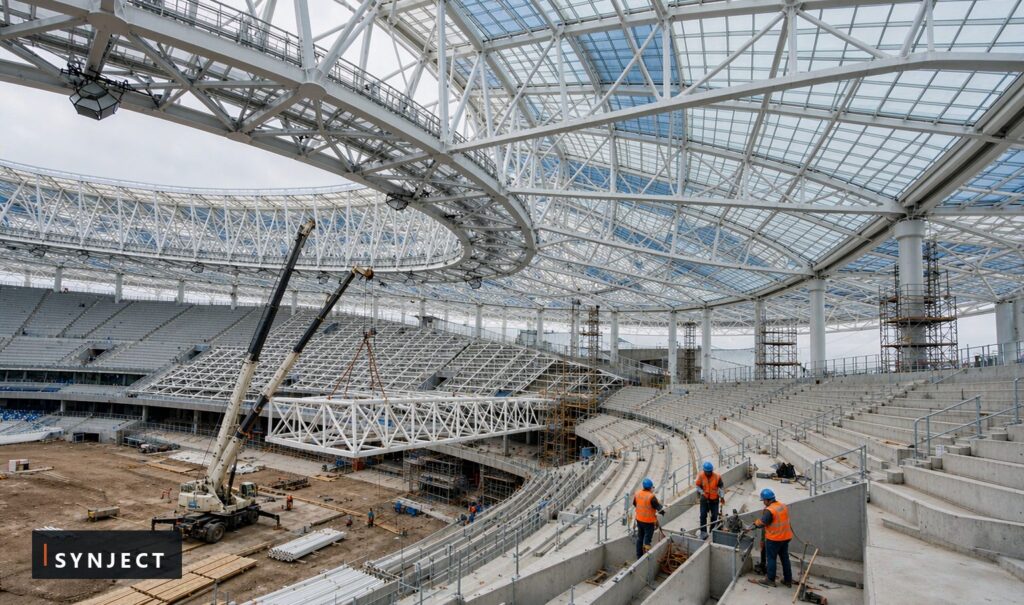
EN 1090-2 EXC3 raises the bar on six specific items, and each one shows up in the shop rather than in the contract. Stadium roofs sit in the high-consequence group because they carry crowds, long spans and heavy wind cycling. Buyers therefore ask for EXC3 by name. However, few tender documents state what the class changes in welding, testing, tolerance and paperwork. This guide sets out those six changes and the evidence a fabricator must produce for each one.
In short, the execution class follows consequence rather than contract value. EN 1090-2 links the class to the consequence of failure, the type of loading and the structural type. Four levels exist, from EXC1 for minor works to EXC4 for the most severe cases. Therefore, a buyer who names a class in the tender gets a consistent price. A buyer who leaves it open gets a price against the easiest reading.
Consequence classes and the four levels
EXC1 covers small structures where failure harms nobody. EXC2 covers ordinary buildings and acts as the default for most steelwork. EXC3 covers structures where failure risks many lives or large economic loss. EXC4 covers special cases such as long-span bridges with severe fatigue duty. For example, a warehouse frame usually runs at EXC2. A stadium roof or a footbridge over a live road usually runs at EXC3.
Level
Consequence of failure
Typical structure
Welding coordination
EXC1
Low, few people affected
Stairs, small canopies, agricultural frames
Basic coordination level
EXC2
Medium, normal building risk
Warehouses, offices, multi-storey frames
Standard quality requirements
EXC3
High, crowds or severe fatigue
Stadium roofs, bridges, heavily cycled frames
Comprehensive quality requirements
EXC4
Very high, exceptional risk
Major long-span bridges, critical infrastructure
Comprehensive plus project rules
Why a stadium usually lands on EXC3
Moreover, three features push a stadium roof into EXC3. First, the structure carries crowds, so the consequence of failure is high. Second, wind cycling produces millions of stress ranges in the welded details. Third, the roof often serves as an escape route and a smoke reservoir. Accordingly, the execution specification should name EXC3 for the primary steel and may allow EXC2 for secondary members.
In practice, the split matters for money. An EN 1090-2 EXC3 scope applied to every purlin and every bracing cleat wastes inspection effort. Applied only to the primary trusses, it protects the details that actually carry fatigue. We therefore ask the designer to publish a class matrix by element group.
2. Six Differences between EXC2 and EXC3
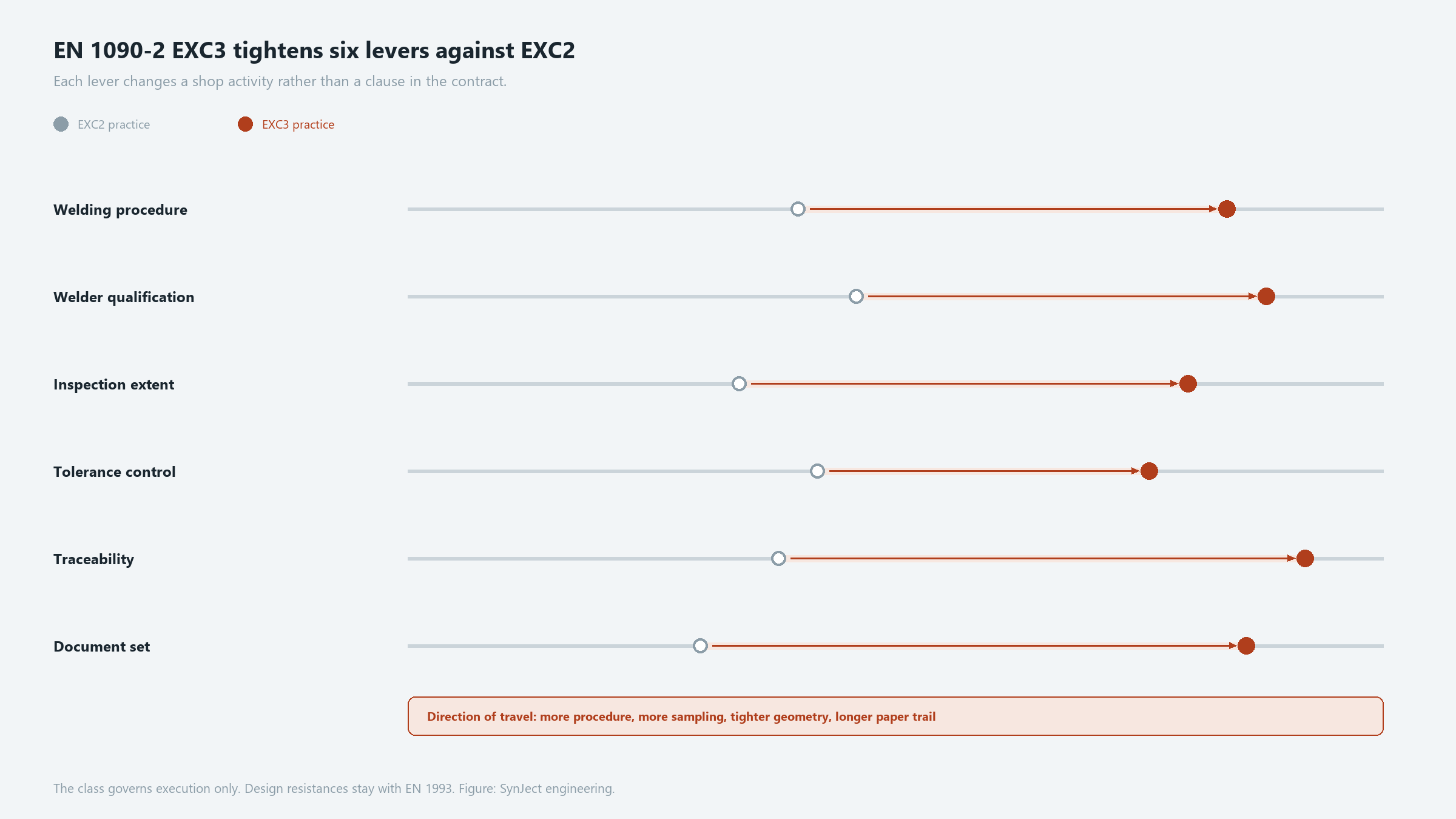
Specifically, six items separate EN 1090-2 EXC3 from EXC2 in daily practice. They cover welding procedures, welder qualification, inspection extent, tolerance, traceability and the document set.
Item
EXC2 in practice
EXC3 in practice
Welding procedure
Pre-qualified procedures accepted for common joints
Procedure tests for the actual grade, thickness and position
Welder qualification
Valid certificate to ISO 9606-1
Valid certificate with joint-specific and position-specific range
Inspection extent
Sampled testing on selected joints
Wider sampling and more joint categories inside scope
Tolerance
Essential plus standard functional tolerances
Tighter functional tolerances on fatigue-sensitive elements
Traceability
Element level linked to the mill certificate
Heat number to finished element, consumables included
Document set
Inspection plan with test records
Full manufacturing dossier with witnessed records
Six levers, one direction. Each lever changes a shop activity rather than a contract clause. Figure: SynJect engineering.
Welding procedure qualification
Therefore, the welding procedure is the first item an auditor opens. With EXC2, a fabricator may use a pre-qualified procedure for a common joint. Under EXC3, the procedure needs a test to ISO 15614-1 that covers the grade, the thickness range and the welding position. Impact testing enters the scope where the design temperature demands it. In addition, the procedure must state preheat and interpass limits, because thick sections crack without them.
Welder and operator qualification
Furthermore, each welder needs a valid certificate to ISO 9606-1 for the joint type and position in use. EXC3 removes the informal allowance for long-serving welders with no paperwork. It also requires a welding coordinator to hold the range and to sign the work off. We therefore keep a live register that links each welder to each qualified range. Consequently, no welder works outside a documented range.
Non-destructive testing proportion
Moreover, EXC3 widens the inspection sample and the category of joints that fall inside it. The project inspection and test plan sets the percentages, and EN 1090-2 sets the minimum extents behind them. Testing starts with visual examination, then moves to ultrasonic or radiographic testing on full-penetration welds. Magnetic particle testing covers fillet welds in fatigue-sensitive details. In addition, the technicians need certification to EN ISO 9712 at level 2.
In practice, the sample size is not the whole story. EXC3 also requires that the sample covers each welder and each joint type, not just each production batch. We therefore spread the sample across welders, shifts and positions. As a result, one weak operator cannot hide behind a good batch average.
3. Geometry, Tolerance and the Fit-Up Budget
Essential tolerances and functional tolerances
By comparison, EN 1090-2 separates two tolerance families. Essential tolerances protect the safety of the structure, and they apply at every class. Functional tolerances protect fit-up, appearance and the interface with other trades. EXC3 tightens the second family wherever the design relies on it.
Public guidance from the UK steel construction knowledge base explains the split in more detail, and it remains the clearest free reference on the four classes.
What tightens on the shop floor
Specifically, an EN 1090-2 EXC3 order changes three numbers in the shop. Straightness of welded columns tightens to L/750 for the stricter cases. Base plate flatness holds at 1 mm per 300 mm. Hole position within a group stays at plus or minus 1 mm, with 3 mm maximum displacement between groups. Furthermore, camber and pre-set need a written record, because a roof that misses its camber will not close at the ridge.
Accordingly, we set the fit-up budget before we cut the first plate. The budget divides the allowance between fabrication, weld shrinkage and site assembly. For a stadium package, the site allowance at a bolted splice is small. Therefore, most of the slack has to sit in the shop jig and in trial assembly.
4. Traceability and the Material Chain
Mill certificates and heat numbers
In practice, every plate arrives with an EN 10204 3.1 mill certificate. That document carries the heat number, the grade and the mechanical results. EXC3 requires the fabricator to keep that identity through cutting, drilling and welding. Consequently, we transfer the heat number onto every cut part before it leaves the saw.
Keeping identity through the works
Moreover, consumables fall inside the same chain. Electrode batches, shielding gas and stud lots all need a record that ties them to the element. EXC3 also asks for the coordinator’s approval before any repair. A repair weld needs its own procedure, its own record and its own testing. Without that link, an auditor cannot tell a repair from original work.
For example, we mark each segment with a unique number that follows it from nesting to dispatch. That number links the drawing, the heat numbers, the welder, the test report and the coating record. As a result, a single lookup answers every question about that segment.
5. Third-Party Surveillance and the Factory Audit
What the notified body actually checks
Specifically, EN 1090-1 requires factory production control, and a notified body certifies it. The audit reviews the quality manual, the welding coordination, the equipment calibration and the traceability system. It also witnesses production and testing on real orders. Therefore, a certificate reflects a live system rather than a framed document.
How surveillance changes with the class
Furthermore, surveillance frequency rises with the execution class. An EXC3 scope brings more frequent visits and a deeper sample of records. The auditor may also ask to witness a procedure test or a non-destructive test. In addition, the certificate states the classes and product types covered. A buyer should read that scope, because a certificate for EXC2 does not cover an EXC3 order.
The legal frame sits in the European construction products regulation, summarised by the European Commission. Harmonised standard EN 1090-1 turns that frame into a declaration of performance and a CE mark.
What a witness point costs on programme
Moreover, each witness point holds production until the inspector arrives. A procedure test may wait two weeks, and a dimensional check may wait three days. Therefore, the inspection and test plan should separate witness points from review points. Review points let work continue while the record waits for signature. Witness points stop the line, so they belong at the few places where the evidence disappears once covered. Good candidates include root passes, coating before assembly and the final dimensional survey.
6. The Documentation Package
Accordingly, the document set is the deliverable that outlives the steel. The table below lists what an EN 1090-2 EXC3 package should contain at handover.
Document
Purpose
Issued by
Manufacturing inspection and test plan
States the checks, the extent and the hold points
Fabricator, approved by the buyer
Welding procedure specifications and reports
Proves each joint has a qualified route
Fabricator
Welder and operator certificates
Proves each operator holds a valid range
Certification body
Non-destructive test reports
Records results and technician level
Testing agency
Dimensional and survey report
Records as-built geometry against tolerance
Fabricator
Coating report with dry film thickness
Proves the corrosivity system and the readings
Fabricator
Material traceability schedule
Links heat numbers to elements
Fabricator
Declaration of performance and CE marking
Confirms the harmonised standard and the class
Fabricator
How to read the dossier in ten minutes
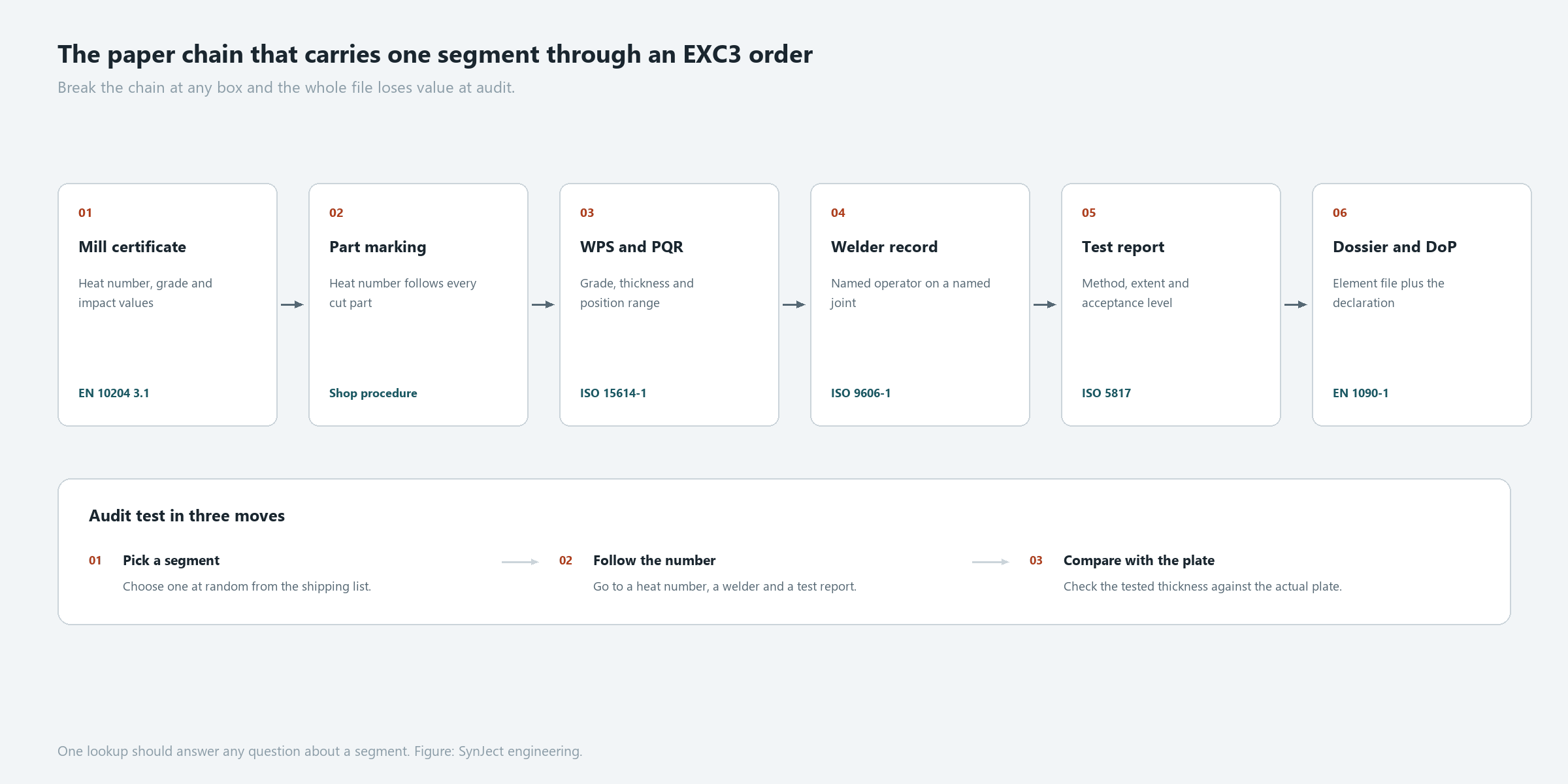
Moreover, a buyer can audit the pack quickly with three checks. First, open the traceability schedule and pick one segment at random. Second, follow that segment to a heat number, a welder and a test report. Third, compare the tested thickness range with the actual plate. If all three close, the system works in practice. If any one breaks, the rest of the pack deserves a deeper look.
The paper chain runs parallel to the steel. Break it at the saw and the whole file loses value. Figure: SynJect engineering.
7. Common Non-Conformities on Stadium Packages
In short, the same handful of findings appear on almost every EN 1090-2 EXC3 audit. Each one traces back to a decision taken before fabrication started.
Finding
Root cause
Control that prevents it
Procedure outside its tested thickness range
Thicker splice plate added late in detailing
Procedure range check at drawing release
Welder outside a qualified position
Overhead repair welded by a shop-qualified operator
Position register plus a site procedure
Traceability broken at the saw
Heat number recorded per plate, not per part
Part level marking before cutting
Tolerance stack missed at the splice
Independent shop and site allowances
One fit-up budget with trial assembly
Coating below the system sheet
Edges and weld spatter left unprepared
Surface preparation check before priming
Test report missing for a repair
Repair treated as routine work
Repair register with mandatory testing
Why the failures cluster at the interfaces
Furthermore, most findings cluster where two parties meet. The designer adds a plate, the shop keeps an older procedure, and the inspector tests the wrong joint. Therefore, a single owner for the class matrix removes most of the risk. We ask for that matrix in writing before we release any drawing. In addition, we log every post-release change against the procedure range.
8. What the Class Does Not Cover
However, buyers sometimes read more into EXC3 than it delivers. The class governs execution, meaning fabrication, assembly, welding, bolting and inspection. It does not cover the design resistances, which belong to EN 1993. It does not cover fire design, which follows EN 1993-1-2 and the fire protection standards. It does not cover cable systems or roof machinery, which follow their own rules.
Moreover, EXC3 does not transfer design responsibility to the fabricator. A shop that holds the certificate still builds to the engineer’s drawings. In addition, the certificate covers the works, not the site. Site welding by a third party falls outside that scope unless the fabricator controls it under the same system. Consequently, the contract should state who owns each activity.
Question
Covered by the class
Covered elsewhere
Member resistance and deflection
No, execution only
EN 1993-1-1 and the design report
Fatigue verification of the detail
Partly, through execution quality
EN 1993-1-9 and the design report
Weld quality and inspection extent
Yes
EN 1090-2 with ISO 5817 acceptance levels
Fire resistance of the assembly
No
EN 1993-1-2 and EN 13381
Cable pre-stress and roof machinery
No
EN 1993-1-11 and machinery standards
9. How SynJect Executes EN 1090-2 EXC3
Specifically, SynJect works to EN 1090-2 execution at EXC2 and EXC3 with CE marking. Our welding coordination follows ISO 3834, and our procedures run to ISO 15614-1 with welders certified to ISO 9606-1. We hold ISO 9001, ISO 45001 and ISO 14001 management certification. For each order we issue an inspection and test plan before we cut steel.
However, we keep the claim precise. Certificate scope and validity change, so we send the current certificate with every prequalification pack. We do not publish a certificate number on this page, because a buyer needs the version that covers the order date. For that reason, always ask for the certificate alongside the quotation.
No standard forces it by name. However, most public stadium roofs adopt EN 1090-2 EXC3 because of crowd loading and fatigue. The execution specification should name the class per element group. If the document stays silent, the fabricator may price the work at EXC2.
Does EXC3 cost much more than EXC2?
The steel price moves little. The inspection, testing and administration add cost, typically a few per cent of the package. The larger cost sits in rework when a shop lacks the system. Therefore, a cheap EXC3 quote usually signals a scope gap.
Can a fabricator with an EXC2 certificate bid for EXC3 work?
Not for the EXC3 scope. The factory production control certificate states the classes covered. A buyer should read that scope before shortlisting. In practice, many works extend their scope, but the extension needs an audit and a new certificate.
Who pays for the third-party inspection?
Usually the buyer, through a separate inspection contract. Sometimes the fabricator includes witnessing in the price. Either way, the inspection and test plan should name the hold points. Otherwise the inspector arrives after the work has moved on.
How long does the documentation take to close?
The dossier closes within two to three weeks after the last dispatch, assuming records stay current. Late traceability is the usual cause of delay. Consequently, we close each segment file as it ships rather than at the end of the order.
Standards referenced. Execution: EN 1090-2, EN 1090-1, ISO 3834, ISO 14731. Welding: ISO 15614-1, ISO 9606-1, ISO 5817, ISO 9712, ISO 17636, ISO 17640, AWS D1.1. Design: EN 1993-1-1, EN 1993-1-2, EN 1993-1-9, EN 1993-1-11. Protection: ISO 12944, EN 13381. Materials: EN 10025-2, EN 10204. Site safety: OSHA 1926 Subpart R.
From complex long-span trusses to strict CE EN-1090 compliances, we engineer certainty. Skip the email delays—connect directly with our Project Director to evaluate your toughest structural specs today.
A 48 team tournament needs roughly 48 training camps, plus fan zones, media centres and accreditation halls. This guide covers the building types, the structural choice for each, and the delivery route to Morocco, Spain and Portugal.
Stadium roof structures fall into four families: cable-net with a compression ring, ETFE cushions, retractable roofs and lattice arches. This guide compares span, structural depth, fatigue duty and erection route, then sets out what a fabricator must prove before award.
Steel structure construction runs as six linked stages, from design basis and detailing through fabrication, erection, connections and handover. This guide sets out the codes, tolerances and inspection points an EPC buyer should audit at each stage.
Not ready to talk yet? Use our interactive project builder to input your dimensions, environmental loads, and compliance requirements. Get a tailored structural outline in minutes.